



Ouray Planning Commissioner Kevin Schiffer and former city building inspector Dave Doherty were selected Monday to fill the two vacancies on the Ouray City Council, restoring a full slate of elected officials on the council as it prepares to tackle a host of challenges in the new year.
Mayor Michael Underwood and councilors Jenny Hart and Peggy Lindsey picked the two men after spending nearly an hour interviewing nine candidates for the two openings. Schiffer will serve a four-year term, while Doherty will serve a two-year term, completing the remainder of Underwood’s four-year term as a councilor. Underwood’s seat on the council opened up when he was elected mayor in November.
Councilors who were charged with filling the vacancies also had to decide which candidate filled each term. They agreed to appoint Schiffer to the longer term.
Schiffer, a familiar presence at council meetings, has “consistency in being here, consistency in knowing what’s going on. He has been here. He’s doing it,” Lindsey said.
Kevin Schiffer is sworn in as a Ouray City Council member by City Clerk Kara Rhoades Monday night. The council used a ranked-choice voting system, ranking nine candidates from one through nine and assigning them scores based on their rank. Erin McIntyre | Ouray County Plaindealer
In front of a room packed with more than 60 people, councilors privately deliberated and ranked their choices for about 10 minutes before Kara Rhoades, the city’s director of finance and administration, announced the winners. She then swore in Schiffer and Doherty, who took their seats behind the dais. Councilors voted to make Schiffer the mayor pro tem, a position that had been held by the newly elected Hart.
The two were picked over seven other candidates: former city councilors Tamara Gulde and Bette Maurer, former Planning Commissioner Mike Hakola, retired utility construction manager John Hart, Realtor Ashley Hineline, business owner Jason Perkins and retired public lands advocate Bruce Ward.
In what’s believed to be a first in Ouray, the council used a ranked-choice voting system to appoint the new councilors. Underwood, Hart and Lindsey ranked candidates in order of preference, one through nine, and assigned scores based on a weighted system in which the higher a candidate was ranked, the more points they received.
City officials did not reveal during Monday’s meeting how Underwood, Hart and Lindsey voted. But documents obtained by the Plaindealer through a public records request show Doherty received the highest score, followed by Schiffer.
Doherty, who has lived in Ouray for nine years and currently works from home as a project manager for an outof- state mechanical contractor, wrote in his letter of interest that he considered applying for a position on the council after reading comments in the Plaindealer from former Mayor Ethan Funk, who lamented at the end of his term last month what he considered a lack of civility in the community and encouraged citizens to unify.
“I have witnessed numerous meetings where comments made by citizens were met with hostility and dismissiveness,” Doherty said.
He said he’s spent time researching city codes, streets and history and is willing to work with fellow councilors and residents.
“I feel like I have a basic understanding of what goes on here and what works for a majority and what doesn’t,” he said.
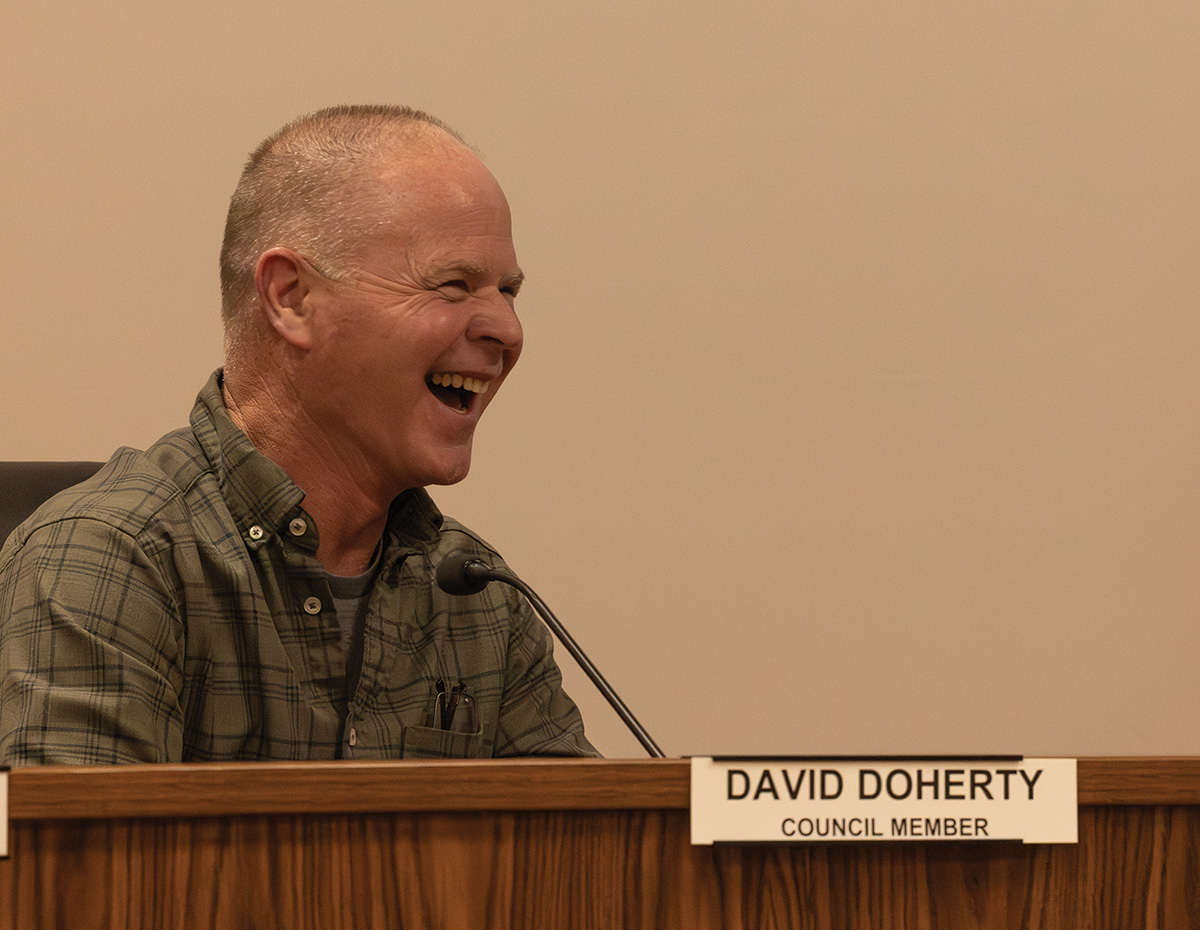
New Councilor Dave Doherty takes his seat after being selected in a ranked choice voting process by Mayor Michael Underwood and councilors Jenny Hart and Peggy Lindsey on Monday night. Erin McIntyre | Ouray County Plaindealer
He said he would focus on maintaining Ouray’s quality of life and noted that while affordable housing is important, it’s not the only factor in determining whether Ouray is an affordable place to live. City leaders, he said, must also be mindful of taxes and utility rates.
The Waterview Homes project is an important source of affordable housing, he said, “but when you get that $234 water bill, is that affordable?”
Schiffer has been active in the community since he and his family moved here in 2020. He currently serves on the Planning Commission, Ouray Economic Development Committee and Ouray Main Street Committee and has been a regular attendee at city council meetings the last three years.
He said he’s worked with councilors on various issues over the years and has a positive relationship with City Administrator Michelle Metteer.
“Positive, strong relationships are essential to effective governance,” he said.
Ouray is not a “real estate club for investors to make a buck,” Schiffer said, but rather “a living, breathing community.” He briefly became emotional and choked up at one point during his remarks to the council, saying he’s invested in the long-term success of the community.
Schiffer cited several goals: completing a rebuild of the main geothermal line that serves the Ouray Hot Springs Pool, stabilizing the police department, paving Oak Street, reviewing how lodging taxes are spent and diversifying the city’s economy so that it isn’t so heavily dependent on tourism.
He said the city needs to continue to manage its housing needs and take whatever steps it can to reduce wildfire risk.
“We live in a forest during a historic drought after a historic beetle kill” without funding to address the problem, he said.
He said the city also needs to revisit the balance between spending money to benefit tourists and spending money to benefit residents. He said while it would be “irresponsible” not to invest in visitors, he believes the city needs to invest more in community assets for its own residents.
Here’s a snapshot of the council’s five-minute interviews with each of the other seven candidates:
Jason Perkins
The co-owner of Ouray Riverside Resort said his experience running a business that includes a campground, cabins, motel rooms, a restaurant, a convenience store and workforce housing for some of the 50 people he employs gives him a well-rounded perspective on the community.
The 10-year resident of Ouray and husband and father of three said his goal would be to promote sustainable tourism and make Ouray a long-term viable option for families.
“How can I help our small town community become bigger and better correctly?” Perkins said.
Ashley Hineline
The Realtor, wife and mother of four children whose family moved to Ouray in 2021 said she believes her career experience makes her the best candidate for council. She said she understands how policy decisions affect people on the ground, and she would approach her position of leadership “with accountability and care.”
Hineline, who has worked in real estate for most of the last 13 years and is currently a special projects advisor with digital advertising agency Topple, said she’s comfortable working with stakeholders who don’t always agree and vowed to listen carefully and ask questions.
She said she would have one goal as a councilor, “to ensure all decisions made by this council are focused on delivering the highest net returns for residents, business owners and guests.”
“Now is not the time to be chasing feathers in caps,” she said.
Tamara Gulde
Gulde, who served the last four years on the council, then lost the mayor’s race to Underwood in November, said immediately after the election that she wouldn’t seek appointment to one of the vacant seats. But she changed her mind after “careful consideration” and encouragement from city residents.
The former 10-year member of the planning commission said she would bring proven leadership and strong relationships to the council. She said she would continue the work she’s done over the past four years by being prepared, responsible and accountable. She said her priorities included advancing the city’s 2021 community plan and refilling Crystal Reservoir, which was drained by the U.S. Forest Service in 2024. A bill that would transfer ownership of the reservoir to the city is pending before Congress.
Mike Hakola
Hakola, an Army veteran and retired facilities manager for the University of California, previously served on the planning commission and unsuccessfully ran for council in 2019.
The 12-year resident of Ouray said he’s seen a deterioration of civility toward new business owners in town and city government become more tone deaf about the needs of residents. He said he wants to come up with fresh ideas to “keep Ouray a great place for everyone to reside” and use taxpayer money responsibly.
With that last goal in mind, Hakola said he would seek to perform a forensic audit of all city purchases and contracts over the last four years to identify how money has been spent. He said he wants to identify the location and condition of all city-owned equipment to determine whether any of it is excess and can be sold or salvaged.
Other goals, he said, include continuing a strong, independent police department, cleaning up unsightly lots and instituting a special tax on “unoccupied residential buildings.”
He also said he would dedicate one day a week to meeting with residents.
John Hart
A Ouray School graduate who has left and returned to Ouray a couple of times, Hart spent six years in the Navy, worked as a journeyman lineman, once owned Ridgway Hardware and worked for 26 years for energy company Arizona Public Service. He called himself a “team builder” who knows how to work with people.
“I have ethics, integrity. I speak my mind. There is no gray area with me. I’m responsible enough to stand behind what I say,” he said.
Hart said he wants to be a liaison between the council and the community, someone residents feel comfortable approaching if they have a complaint. He said the council needs to remember that it works for the public and be conscientious about how it spends tax money.
“I’m very conscious of where money is spent and what is done with that money,” he said. “I think somewhere along the way that’s been missed.”
Bette Maurer
The 35-year resident of Ouray served six years on the council between 2013 and 2019. She’s a longtime volunteer with the Ouray Elks Lodge who currently serves on the boards of the Ouray Chamber Resort Association and the Six Basins Project, a nonprofit organization dedicated to preserving the landscape in the Yankee Boy Basin and Imogene Pass areas above Ouray.
Maurer said she would bring a historical perspective to the city and its issues. She said she would focus on the city’s budget and use things she learned through attending an educational program offered by the Colorado Municipal League to benefit Ouray.
Bruce Ward
The newest resident of Ouray among the nine candidates, Ward has lived in town since October 2024. He is the founder and executive producer of the TV series “America’s Forests with Chuck Leavell” and the retired founder of Choose Outdoors, a Denver-based nonprofit that promotes public lands.
He said while he’s lived in Ouray for just more than a year, he’s passionate about the city and doesn’t want to see it become Moab, which he said is an overcommercialized, overdeveloped tourist attraction.
He said after listening to other candidates’ interviews he’s not sure he’s the best person to serve on council, and he acknowledged he wished he knew more about the city’s priorities. But he touted his ability to bring diverse groups together, noting he’s worked with all levels of government, energy companies, timber companies and various corporations. And he said one of his biggest goals as a councilor would be to mitigate wildfire danger in the city.
Meeting with the mayor
Each candidate was asked the same three questions: why they are the best choice and what they would bring to the table, their goals and whether they would be willing to meet with the mayor once a month. Specifically, Underwood said he wants to hear councilors’ “thoughts and ideas concerning the forward direction of our shared community.”
Eight of the nine candidates said they would be open to the monthly meetings. Gulde, though, said she couldn’t guarantee she would be willing to meet with Underwood regularly.
She said she had a four-year record of engaging regularly with the mayor and fellow councilors and, if appointed, would continue to do so.
She noted the city’s charter doesn’t require councilors to meet with the mayor regularly, and that the mayor and councilors hold equal legislative authority. She said she would rather convene with the mayor and other councilors through properly noticed public meetings than a “mandatory and unilateral requirement” to meet one-on-one with the mayor.
Underwood countered that his request to meet regularly with individual councilors wasn’t a mandate.
Jeff Roberts, executive director of the Colorado Freedom of Information Coalition, told the Plaindealer the Colorado Open Meetings Law permits meetings between the mayor and individual members of the council to discuss public business. He said elected officials have to be careful, however, not to use those meetings in a way that circumvents the law or violates the spirit of it.
That can happen if a councilor’s thoughts and positions on a particular issue are then relayed to another councilor, he said. Those sorts of meetings where the elected officials use each other to pass on information to discuss public business and make decisions are called serial or “daisy-chain” meetings.
“Then it essentially becomes a meeting of three or more members — a meeting subject to the law but a meeting the public cannot attend and may not know about,” Roberts said.
He said there is no case law on serial meetings in Colorado, but a district court judge ruled in 2023 that four members of the Douglas County School Board violated the open meetings law by discussing the job performance of the district superintendent in a series of one-on-one meetings — outside of public view — and deciding to end the superintendent’s employment “either by resignation or by termination.”
In that case, the judge found the elected officials used those oneon- one discussions to arrive at a decision they later rubber-stamped in a public meeting.
“Circumventing the statute by a series of private one-on-one meetings at which public business is discussed and/or decisions reached is a violation of the purpose of the statute, not just its spirit,” Douglas County District Court Judge Jeffrey Holmes wrote in his decision.
HOW THEY VOTED
The Ouray City Council used a ranked choice voting system to appoint the two newest members of the council. Mayor Michael Underwood and councilors Jenny Hart and Peggy Lindsey each ranked candidates in order of preference, one through nine, in a weighted system that assigned points based on ranking.
The first choice, for example, received 1 point, while the ninth choice received 0.039 points. City officials added up the points, and the two candidates with the most points won. Here’s how each council member ranked the candidates:
Mayor Michael Underwood
1. John Hart
2. Ashley Hineline
3. Dave Doherty
4. Mike Hakola
5. Jason Perkins
6. Bette Maurer
7. Kevin Schiffer
8. Bruce Ward
9. Tamara Gulde
Councilor Jenny Hart
1. Tamara Gulde
2. Dave Doherty
3. Kevin Schiffer
4. Bruce Ward
5. Bette Maurer
6. John Hart
7. Jason Perkins
8. Ashley Hineline
9. Mike Hakola
Councilor Peggy Lindsey
1. Kevin Schiffer
2. Jason Perkins
3. Dave Doherty
4. Mike Hakola
5. John Hart
6. Bette Maurer
7. Ashley Hineline
8. Tamara Gulde
9. Bruce Ward
The final results
Dave Doherty – 1.556 points
Kevin Schiffer – 1.532
John Hart – 1.329
Tamara Gulde – 1.098
Jason Perkins – 0.952
Ashley Hineline – 0.813
Mike Hakola – 0.632
Bette Maurer – 0.461
Bruce Ward – 0.394