



It took Mike Gibbs all of five seconds on that morning in early August to figure out it was time to execute one of the world’s most complicated rope rescues.
A car had tumbled 320 feet off the edge of the Million Dollar Highway a few miles south of Ouray. The crumpled silver Honda was sitting in a stream at the bottom of the chasm with an unknown number of victims inside. Gibbs had no idea if anyone was alive down there.
What he did know was that the low-angle cliff above the wreck would be dangerous for rescuers to rappel down with litters, medical bags and metal-cutting tools. Such cliffs are notorious for slicing ropes and raining rocks down on rescuers and victims.
“I was looking at chaos with all the trees and rocks and bushes,” Gibbs said. “There was no way we could get a person to the ground safely going down that cliff.”
Gibbs’ three decades of rescue training told him that he needed to get his Ouray Mountain Rescue Team members to the wreck using a web of horizontal rigging with a vertical line in the middle that could lower and raise rescuers and victims as if they were in a rudimentary rope elevator. The maneuver is called a Norwegian Reeve.
As a world-class rope rigger and owner of the Ouray-based Rigging for Rescue business, Gibbs had done the reeve many times in practice sessions. He had taught the method to rescuers around the world for decades. But he had never done the reeve for real.
“When I saw the terrain, I thought to myself, ‘Well, look at that. We’re actually going to do a Norwegian Reeve,’ ” Gibbs said.
His next thought: “Let’s get busy.”
Rigging for Rescue founder Mike Gibbs, portrait by William Woody – Special to the Plaindealer
There was a sturdy evergreen surrounded by large boulders on a rock outcropping behind him across U.S. Highway 550. That could serve as an anchor along with several heavy-duty fire and rescue trucks that would be parked on the highway. Gibbs eyeballed another stout evergreen across the canyon that ropes could be fixed to.
The team began hauling out bags containing coils of rope and clanking piles of carabiners, pulleys, carriage devices and hoists.
The first order of reeve business was to use a special rigging gun to shoot a monofilament line across the canyon — the approximate length of a football field.
Team members who had traversed a rough, obstacle-course section of trail and rappelled down a sheer rock face on the other side were ready to snag the line. It landed perfectly on the first try. That line was then used as a guide to haul a rope across. Using a pulley system, eventually three horizontal ropes would be secured across the chasm to create the scaffold of track and tag lines for the hoist line that would complete the reeve with a vertical component.
***
While the team members above the wrecked vehicle were rigging the reeve, two rescuers had made their way down to the car, which sat upside-down in a shallow stream.
Ouray Mountain Rescue Team member Tim Pasek was one of the first to reach the vehicle. Its top was squashed down to the level of the car body. He saw a children’s book in the nearby rocks. He saw two small feet pointing to one side of the back seat. Then he heard a child yelling.
An 11-year-old girl had survived the crashing, tumbling, spinning ride down the canyon. Pasek and fellow team member Jeff Skoloda stuffed heating blankets into the car to keep the girl warm while they took cutting tools to the vehicle to extricate her from where she was hanging by her seat belt.
She had a broken arm but no other serious injuries. Two adults in the front seat were dead.
With this news radioed to Gibbs and the other riggers up top, the reeve was put into action. Team member Annie Quathamer would be the first to be pulled across the horizontal lines to the hoist. With the help of a mechanical wench, she was lowered to the crash site as if she was dangling from a crane. She, and the litter she carried, were gently deposited just feet from the wreck.
Quathamer helped secure the girl in the litter. With Gibbs directing, the girl and Pasek were hoisted up to the horizontal lines. Pasek said when they had reached a height about three stories up, the girl nervously asked him, “Could we fall?”
He assured her they wouldn’t. He explained that the reeve was sturdy and was working just as planned.
After team members cranked them to the edge of the cliff, a waiting ambulance took the victim to a helicopter that had been staged in Ouray and she was flown to a Front Range hospital.
With the girl safe, the reeve work wasn’t finished.
Over the next three to four hours, Gibbs would direct three repeats of the reeve elevator. A bag of heavy rocks serving as ballast was winched out and lowered to the rescuers. They emptied the rocks and clipped on to the rope hoist to be brought safely out of the canyon, one at a time.
One rescuer brought up the bodies of the deceased.
The Norwegian Reeve had done its job and Gibbs and the team began to dismantle the rigging — an operation that would take several more hours.
No rescuers were injured. “Getting out of there would have been very hazardous without the reeve,” Pasek said.
And the reeve might not have happened without Gibbs, according to those who have worked with him over the decades.
“There is no way our team would be as amazing as it is without Mr. Gibbs. He’s been a huge asset for our team,” said Sam Rushing, who recently retired from Ouray Mountain Rescue after more than three decades. “When I would see him showing up on a rescue, I would think, ‘Hot damn, we’ve got this one covered.’ ”
***
Gibbs is sure of his rigging for rescue skills. He knows he can pull off a Norwegian Reeve under pressure. But he is humble about his importance to the team.
“We have a saying on the Ouray Mountain Rescue Team: No Individual Heroes. And we believe in that credo,” Gibbs wrote in an email asking that an article not focus on him. “It is a team effort with many component parts ultimately creating that synergistic effect that contributes to our success.”
That said, on the vertigo-inducing edge of Highway 550 with crash victims below, or in the cavernous Rigging for Rescue building at the north end of Ouray, Gibbs’ expertise is often in the forefront.
Rushing said that over the years when Gibbs arrived on a rescue scene, everyone would back off and go quiet while he silently calculated the physics of a rigging and then brought the rest of the team in on his thinking before they scrambled into action.
In his Rigging for Rescue building — an old water bottling plant Gibbs has turned into a training magnet for rescuers from around the world — the trainees show the same deference to a man they know has serious rope cred in the rescue world.
Carabiners click clack through the building as the rescuers dangle from ropes to practice hauling dummies up and down from a balcony. While they work at less-technical rescues, Gibbs efficiently rigs up a demonstration of a Norwegian Reeve between two posts. The trainees peek over the balcony to watch Gibbs deftly rig lines with his Popeye-muscled arms.
“It’s a very elegant and a very precise rope system,” Gibbs explained as he uncoiled ropes and clipped a reeve system together.
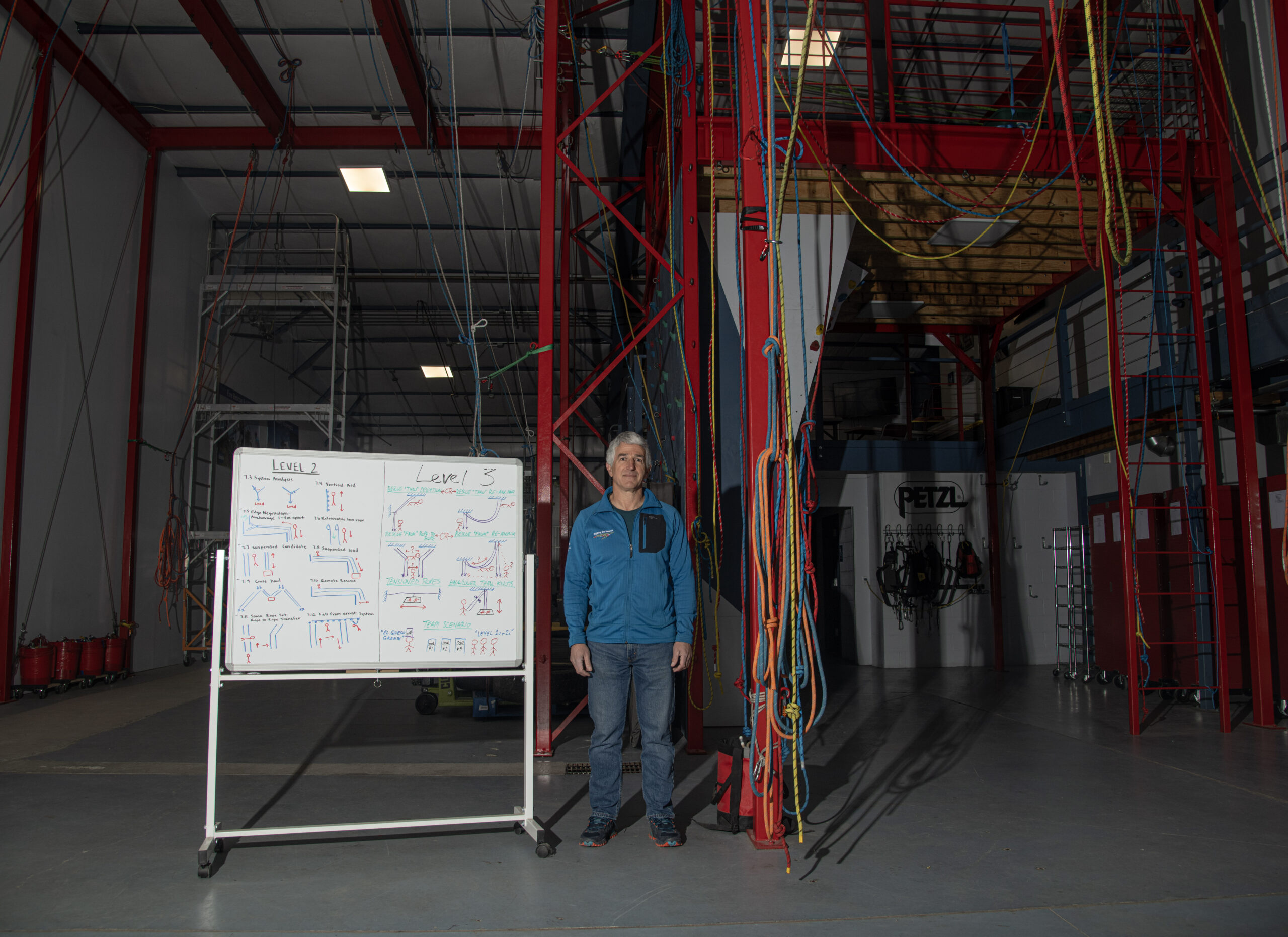
Rigging for Rescue founder Mike Gibbs stands for a portrait inside his training and teaching center in Ouray on Feb. 5, 2026. Photo by William Woody – Special to the Plaindealer
Gibbs came to this world of rescuing people from tough spots after many years of recreational rock and ice climbing. It began in the Cascade Mountains when he was growing up in the Pacific Northwest.
After graduating with a finance degree from the University of Oregon, he and his wife, Joanie, made their way to Colorado where they hopped around ski and climbing communities from Steamboat Springs to Telluride to Silverton before finally settling in Ouray. They have been there for the past 25 years.
Gibbs became one of the founding members of the Ouray Ice Park in the early 1990s. He joined the renowned and award-winning Ouray Mountain Rescue Team in the spring of 1996. Four years later, he took his first Rigging for Rescue class and eventually bought the rescue-instruction business in 2001.
He also owned San Juan Mountain Guides in those years but sold it when the pressure of running two travel- heavy enterprises got to be too much. “I was working seven days a week. I had two land lines and two fax machines. I decided I would change my focus to rescues,” he said.
Since then, Gibbs’ business has become one of half a dozen well-known in the global rescue rigging world. He has trained rescuers across the country, including Hawaii and Alaska, and in Chile, South Africa and Iceland. He recently returned from his 13th training session in Iceland.
He has taught classes for the National Park Service, the Department of Defense and a variety of industries, including ski areas, window washers, dam inspectors and oil rig workers.
He has provided rigging training for the 21 Ouray Mountain Rescue Team members, including 10 who now have varying levels of competence to construct a reeve.
He has also trained his own family. Gibbs’ son, Rock, was recently certified as a rigging rescuer.
Gibbs and his fellow team members know that not everything can be taught in the high altitude, high stress world of tricky rescues. As the Aug. 5, 2025, accident near Ouray demonstrated, rescuers know that what flickers through Gibbs’ brain on a challenging scene is much more complicated than a webbing of ropes. Some of it can’t be taught.
“You have to take in a lot of variables when you are sizing up a scene,” Gibbs said. “It’s an art and craft more than it is a science.”
And, he stresses as always, that no one can do a Norwegian Reeve alone on a real rescue. It takes a strong team effort.
Nancy Lofholm is a longtime, award-winning journalist who lives in Grand Junction. Though she retired from the Denver Post in 2015, she still reports and writes articles for several publications in Colorado.