



She spent three months carefully itemizing everything they lost in the fire, trying to remember what was in kitchen drawers and closets.
Every piece of silverware, furniture, clothing, appliances and electronics.
She tried to jog her memory by looking through her phone at photos of family gatherings, scrutinizing the backgrounds of birthday parties and holiday get-togethers.
Behind these smiling faces in happier times were traces of the possessions they lost when the house burned.
One by one, she added each item to the list.
Upright vacuum. Women’s snow boots. Cheese grater. Pack of toilet paper, 18 count. Jigsaw puzzles.
“That took years off my life,” said Amy Stauffer, who lost her home in the 313-acre wildfire on Simms Mesa in northern Ouray County, which grew out of a U.S. Forest Service prescribed burn in May 2022.
In this photo from May 2022, Rudy and Amy Stauffer stand on the front steps of their burned home after it was destroyed by the Simms Mesa wildfire. The couple was able to re-use the steps on their new home, as well as the foundation, when Rudy re-built it.
Erin McIntyre – Ouray County Plaindealer
The prescribed burn, meant to reduce the risk of devastating wildfires, was whipped by high winds into an uncontrolled blaze with 100-foot-tall flames after it was left unattended by federal fire officials during a red flag warning.
Amy and her husband, Rudy, escaped, but their cat was burned so badly they had to euthanize her.
As if losing their home in a fire wasn’t bad enough, completing the paperwork to try to get compensation for damages added insult to injury.
It all added up to 61 pages — many of them double- sided — of a tort claim against the federal government, a form required to claim damages when someone is harmed by the government or its employees.
The Stauffers submitted that claim in 2023. They still haven’t received an answer.
The couple requested $1,585,984 in property damages and paid roughly $5,000 to gather the materials for the claim, including payment for an arborist to calculate the value of the torched trees, as well as topographical maps and appraisals.
Three years after the fire, the Stauffers haven’t received a dime from the agency whose actions caused them to lose their home.
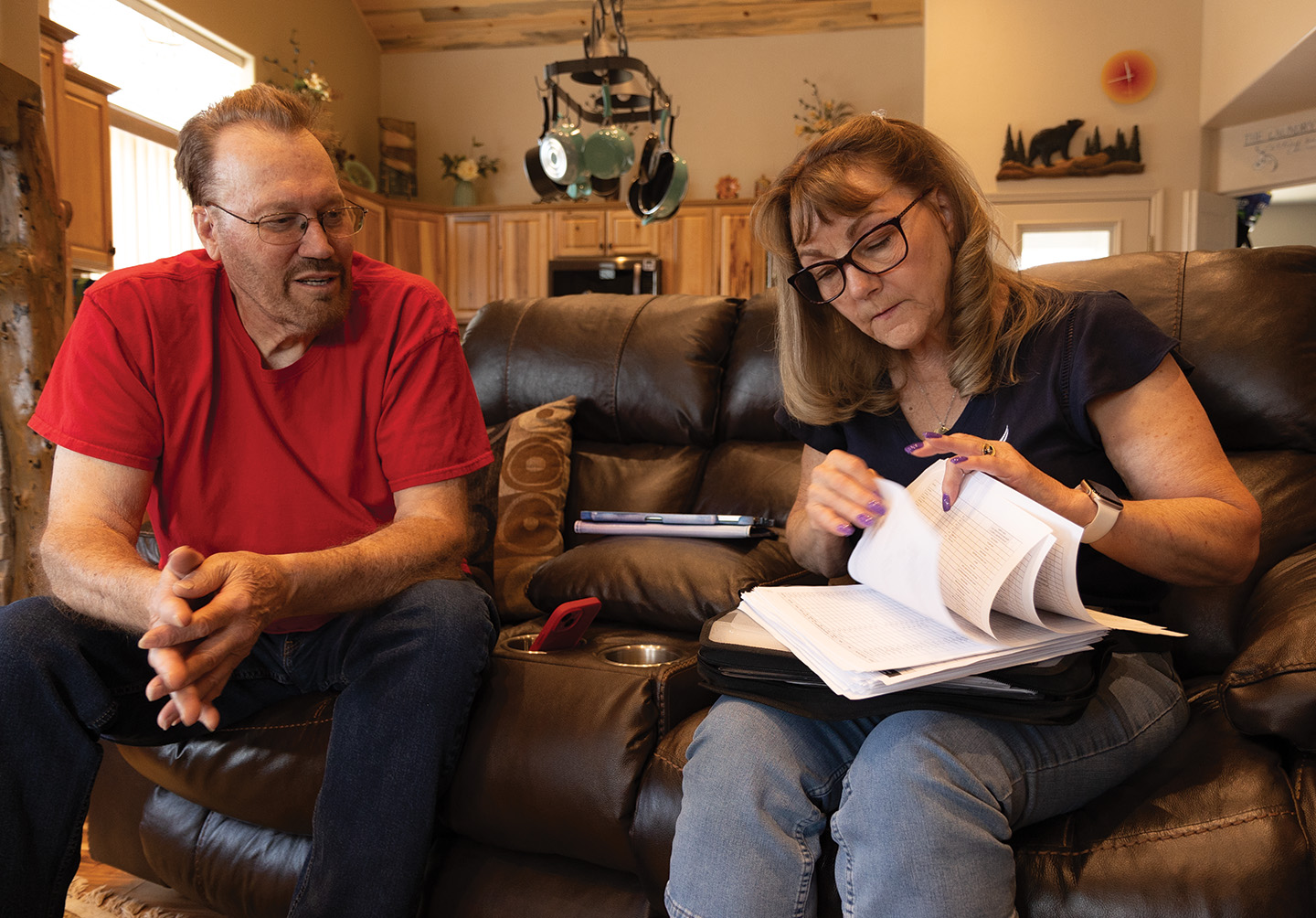
Rudy and Amy Stauffer look through more than 60 pages of a tort claim they filed with the federal government, asking for compensation from the fire that destroyed their home in 2022 after a prescribed burn set by the U.S. Forest Service turned into the Simms Mesa wildfire. They spent months of their own time and an estimated $5,000 to gather materials for the claim paperwork, and have not received any compensation yet. They have since rebuilt a new home on the old foundation. Erin McIntyre – Ouray County Plaindealer
The Stauffers have been waiting for the federal government to deny their claim before deciding whether to file a lawsuit for compensation.
So far, they haven’t received an answer. Amy said she was hopeful when a Forest Service employee told her in January that her claim was next on her list, and to call back in March and see if there was a decision.
But when she called back in March, that woman was no longer in her position. It’s not clear what happened, and Amy hasn’t had luck getting information since.
It’s not clear if or when they will receive an answer. The Forest Service employee handling the Stauffers’ claim did not respond to a voicemail or email from the Plaindealer by deadline.
And now, a full three years after the Forest Service’s prescribed burn torched their dream home, the Stauffers remain in limbo, waiting for any chance of compensation from the government agency that harmed them.
In that time, they used their own home insurance money and savings to rebuild in the same place, on Wildcat Canyon Road.
They returned to the windblown, charred landscape, wizened trees standing sentinel in the dusty, ashen air.
“It was like a war zone,” recalled their son, Randy, who helped rebuild the home, along with the rest of their combined family with six children, who contributed various skills to frame, install plumbing and more.
At first, their daughter tried to convince them to not rebuild where the old house burned.
“She told us, I don’t want you to move back up there,” Amy said. “But what choice did we have?”
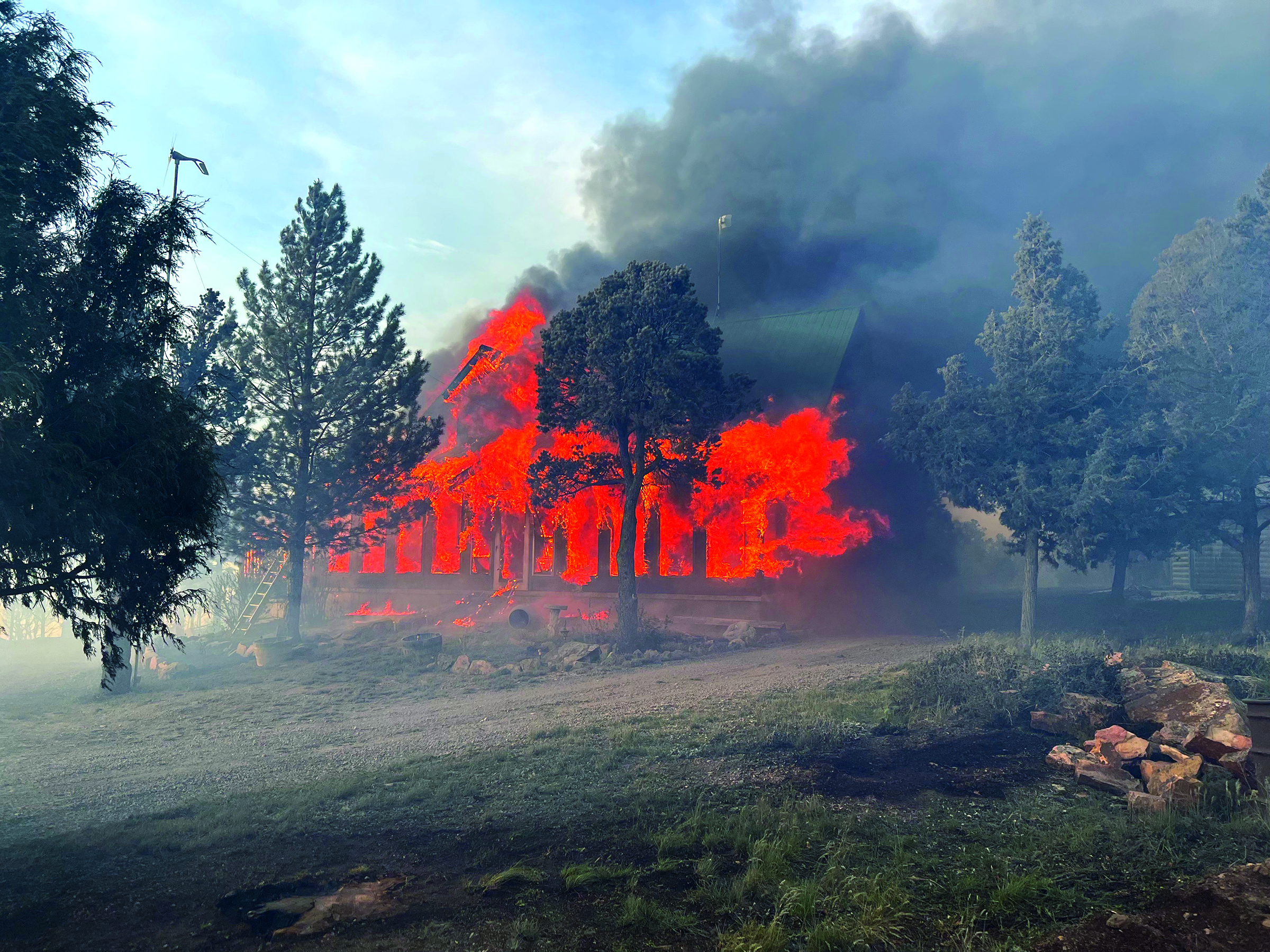
This photo was taken of the Stauffers’ home on May 19, 2022, the day a prescribed burn set by the U.S. Forest Service turned into the Simms Fire. The Stauffers escaped with their dogs and a few possessions.
Photo courtesy Rudy Stauffer
They saved at least $80,000 by reusing the old foundation. Even more savings came from Rudy building the house himself — the former contractor came out of retirement to rebuild it.
After more than 10 months of construction, the Stauffers moved into their new home in the old spot in March 2024.
But even after moving into a brand-new house, they faced challenges. One night, the smell of smoke woke Amy up. She panicked. It turned out embers reignited in the wood stove and were burning – the house was not on fire.
She had nightmares for months, ones where her brain replayed the day the house burned down, and she ran through the house grabbing things.
“Why didn’t I get that and why didn’t I do this?” kept running through her head.
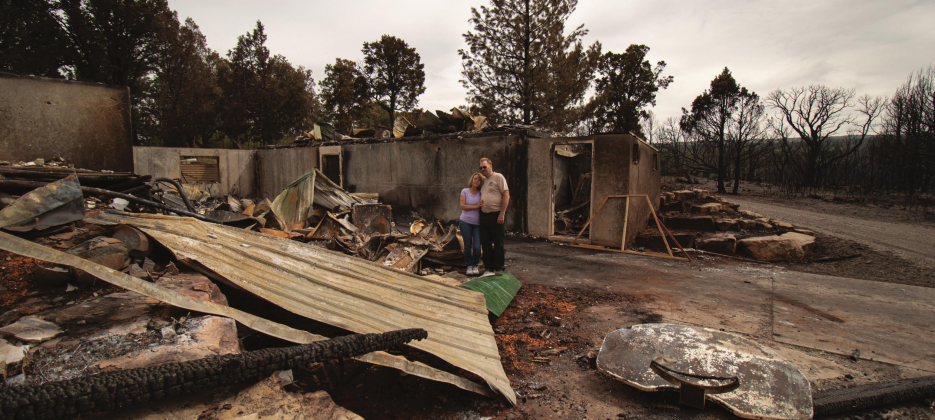
Amy and Rudy Stauffer stand in the rubble of their burned home in May 2022, after it was destroyed by the Simms Fire. Erin McIntyre – Ouray County Plaindealer
The constant rethinking of how they rushed to gather what they could and escape before the fire consumed the house lingered for months.
Feelings of anger and grief tempered over time into acceptance, though the conclusion of the Forest Service’s investigation into the fire — determining there was no gross negligence — is something they still disagree with today.
“There was negligence on somebody’s part,” Amy said.
“It seems like they should have posted a two-man crew up there for as long as (the fire) was hot,” Rudy said.
But there’s not much they can do about that, and the Stauffers have focused on what they can control. They filed the claim and continue to wait. And they’ve decided to be happy.
“You have to look for the good in things, and find joy,” she said.
Before, they had a secluded house in the forest. Now, they can see for miles and miles, with a view of the mesas on the horizon.
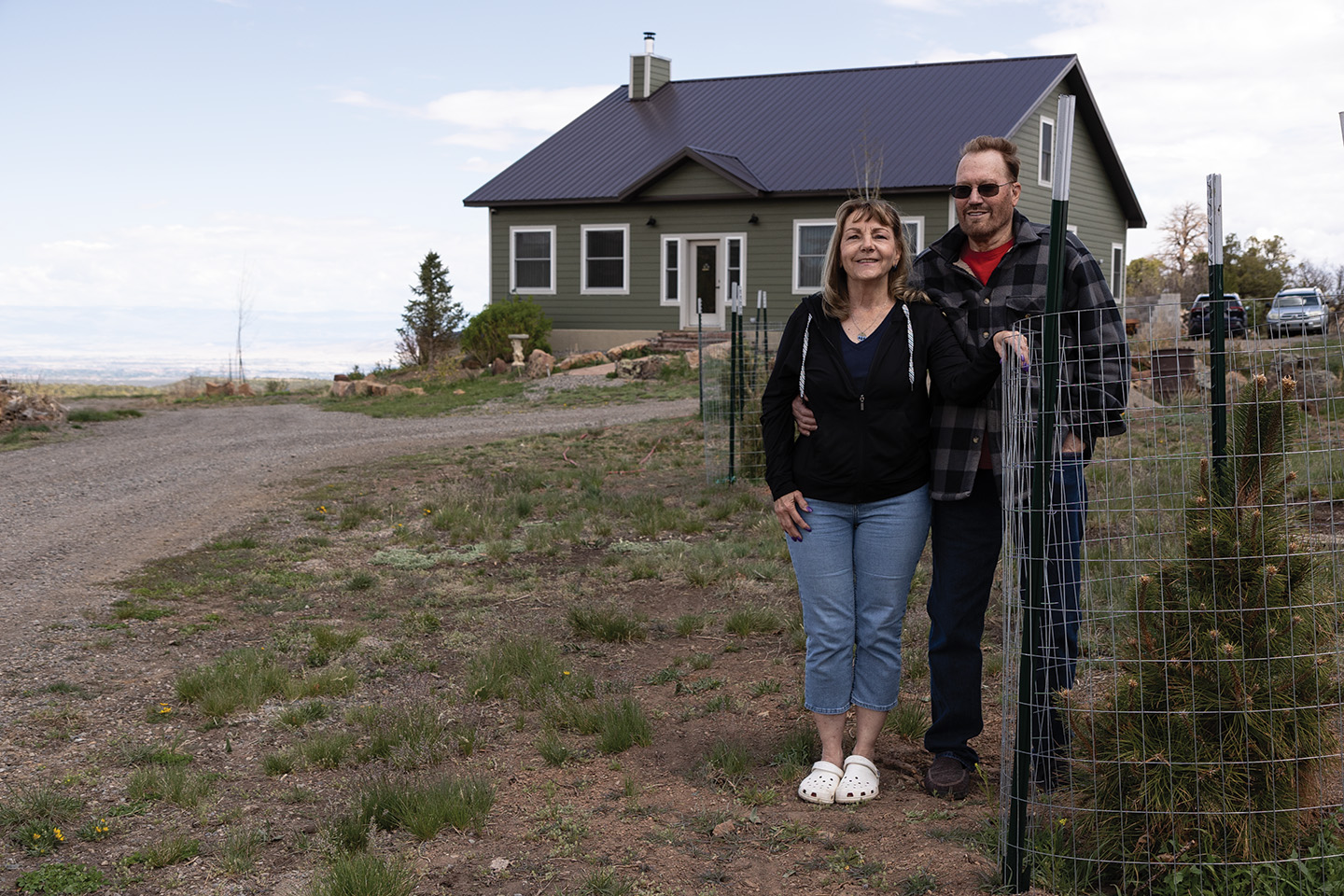
Amy and Rudy Stauffer stand at the edge of their driveway, where they’ve planted new trees on their property after losing their home in the Simms Mesa wildfire which that grew out of a prescribed burn set by the U.S. Forest Service in 2022. After three years of waiting, they still have not received any compensation from the federal government.
Erin McIntyre – Ouray County Plaindealer
They’ve been surrounded with love and support from others since they lost their home in the fire. Even total strangers who recognized them from their photos in the newspaper approached them in Wal-Mart, dug into their pockets and gave them money, or sent them sympathy cards in the mail.
Those actions solidified their belief that people are basically good.
“There’s a lot of really good people out there that don’t get credit,” Amy said.
They even had a kitten show up out of nowhere, after euthanizing their cat that was burned. Now they have Mac, named for the M on the tabby’s forehead.
Earlier this spring, their fellow church members showed up to help them plant 230 seedlings, which they hope will eventually grow as large as the Ponderosa pine trees and spruces that burned.
“They say when you plant a tree, you plant it for somebody else, especially at our age,” Rudy said.
Amy is now 66. Rudy is 75. They both say the stress of dealing with the fire aftermath aged them, and it’s even more frustrating to not have an answer now.
“Will we even be alive when they decide?” Amy said. “We don’t know, and that, to me, is a travesty.”