

Videos Login Subscribe Renew E-edition
logo
ePaper
coogle_play
app_store
  • News
  • Features
  • Opinion
    • Columns
    • Letters
  • Obituaries
  • Classifieds
    • Place a Classified
  • Advertise
  • Contact us
  • Legal Notices
    • Read Statewide Legal Notices
  • Archives
    • News
    • Features
    • Opinion
      • Columns
      • Letters
    • Obituaries
    • Classifieds
      • Place a Classified
    • Advertise
    • Contact us
    • Legal Notices
      • Read Statewide Legal Notices
    • Archives
Banding project helps monitor migratory species
Feature
By Mary Menz mary.t.menz@gmail.com, on September 6, 2023
Banding project helps monitor migratory species

Migratory birds take cues from nature to know when they should head south for the winter. Typically, these are birds that depend on insects and aquatic life as their primary food sources—food sources are not available during winter. In spring, the birds return to their northerly breeding grounds where food is again plentiful.

It’s thought that diminishing food sources, fewer daylight hours, and lower temperatures provide birds with indicators they need to begin fall migration to warmer climates. It may also be that many species of birds are genetically programmed for this behavior.

Because birds can’t tell us the reasons they migrate or when, wildlife biologists track bird migration in a variety of ways. In addition to live migration maps that use radar imagery to identify vast populations of birds migrating during spring and fall (visible online at Birdcast.info), observers on the ground verify the radar imagery as they report sightings of migrating birds using Ebird. Both of these citizen science applications are important for gathering migration data, but bird banding and nano-tagging are even more important indicators of migration.

On the ground tracking also occurs at seasonal migratory bird banding stations. In Colorado there are at least a dozen banding stations. At these stations, ornithologists operating under federal banding permits, set up mist nets and capture birds to be banded. After applying a permanent aluminum leg band with a nine-digit number, birds are released; but, not before a thorough evaluation is completed. This includes wing and tail feather measurements, weight, sex and species identification, and aging. All of this data is logged online on the US Geological Society’s North American Bird Banding Program’s website, where anyone can report a found bird with a leg band to determine where and when it was banded.

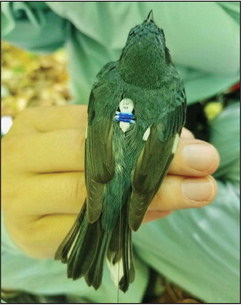
Some stations are now fitting migratory birds with tiny Motus radio-transmitter tags attached to a lightweight elastic harness. The harness fits over the feet and across the bird’s back under feathers and carries a geolocator tag about the size of a pinky fingernail. Like an aluminum leg band, the tags are numbered and recorded for specific birds. When a bird is caught in a mist net, the banding team will log the recapture and look up when and where it was originally banded, thereby gathering basic information about migration.

Spotted towhee receives leg band for tracking

Motus tags, while expensive and not yet widely used, transmit better data to researchers looking at migration routes, stopovers, and final destinations. All of which provide important data sets to help conservation of migratory species and their necessary habitats.
Birds, bats and even insects have been fitted with Motus tags and can be monitored if they fly within a few kilometers of a Motus receiver tower. The Motus system puts information gathering on the fast track. Instead of relying on a bird to actually land in a net multiple times, in one country or another, tagging and tracking birds with nanotags allows real-time monitoring of species.

About Migratory Bird Banding Stations

Depending on the stopover location, the weather, and the quality of habitat, birds can stay for a few days or a week or two—enough to get them ready for their next travel day. Locations rich in habitat and food sources provide the best locations for banding stations.

Ridgway State Park, which has hosted an annual fall bird banding station since 2006, sees a lot of Wilson’s Warblers (and other warblers) during its banding season. The station is open Sept. 4-15. There’s a day for the public to come watch – this Saturday, Sept. 9 from 8-11 a.m.

From there, the federally-permitted bander heads to Grand Junction for one month of banding at the Grand Valley Audubon Nature Preserve at Connected Lakes, from Sept. 18 to Oct. 13. Stop in to see these tiny little birds up close and personal at a banding station.

Wilson’s Warblers leave breeding grounds in the Yukon and travel to wintering areas in Central America. On each stopover during its more than 4,000-mile journey, a bird will gain up to 9% of its body weight to fuel the next leg of its flight. Banding stations on the Western Slope aren’t currently nano-tagging migratory birds, but are expected to in the future. Stations in Montana and Canada are using them in limited capacity.

Mary Menz is a naturalist, Colorado Native Plant Master, and author of two books on wildflowers. The most recent is Wildflowers of Colorado’s Western Slope, available at area book sellers. Contact her via email at mary.t.menz@gmail.com.

Dispute over extended background check leads to Ouray police chief’s last day
Main, News...
Dispute over extended background check leads to Ouray police chief’s last day
City administrator declines to make interim chief permanent
By Mike Wiggins 
December 17, 2025
Ouray Interim Police Chief Daric Harvey is leaving his job over his objections to City Administrator Michelle Metteer’s insistence that he undergo a second, more extensive background check to determin...
this is a test
Commissioners fight over board leadership position
Main, News...
Commissioners fight over board leadership position
Niece to serve as chairperson after he, Nauer reject requests from Padgett's backers to appoint her
By By Lia Salvatierra and Erin McIntyre lia@ouraynews.com erin@ouraynews.com 
December 17, 2025
For the second year in a row, Ouray County commissioners fought over who should serve as board chairperson, rejecting requests from supporters of Commissioner Lynn Padgett to appoint her to the positi...
this is a test
News
Space to Create owner, management address complaints, pledge fixes
By Lia Salvatierra lia@ouraynews.com 
December 17, 2025
Space to Create’s owner and property management company are pledging to remedy issues with Ouray County’s first affordable housing project and re-establish strong communication with residents after re...
this is a test
News
Council qualifies homebuyer for deed-restricted unit
December 17, 2025
The Ridgway Town Council approved qualifying a homebuyer for a deed-restricted unit in the Vista Park Commons neighborhood after discussing whether the unit was advertised fairly. The council, acting ...
this is a test
News
Following concerns, town delays adopting anti-idling ordinance
By Lia Salvatierra lia@ouraynews.com 
December 17, 2025
Ridgway town councilors decided to delay final approval of a new anti-idling ordinance after hearing public concerns and discussing other issues related to the new rules during a Dec. 10 regular meeti...
this is a test
News
County pauses most 4-H Center events
Budget cuts eliminated staff; work session planned with new manager
By Lia Salvatierra lia@ouraynews.com 
December 17, 2025
Ouray County leaders decided Tuesday to cancel most 4-H Event Center and Fairgrounds events after San Juan Skijoring in January, until the county comes up with a plan to manage the space. It’s unclear...
this is a test
ePaper
coogle_play
app_store
ePaper
coogle_play
app_store
Editor Picks
Columns, Opinion...
LETTER TO THE EDITOR
Column about election integrity not worth space in newspaper
December 17, 2025
Dear Editor: The Dec. 4-10 edition of the Plaindealer made me realize just how long it’s been since that moniker has had anything to do with the paper’s content. And now it appears, with the publicati...
this is a test
How a cook, engineers saved Liberty Bell Mine
Columns, Opinion...
How a cook, engineers saved Liberty Bell Mine
December 17, 2025
The winter of 1905-06 was a dangerous time for the high-altitude mines above Telluride as snowstorm after snowstorm hit the region. Just four years earlier, the infamous 1902 "White Death" avalanche h...
this is a test
Columns, Opinion...
LETTER TO THE EDITOR
Two types of ‘creative’ people, 15 years apart
December 17, 2025
Dear Editor: I read the dichotomous reports in the Ouray County Plaindealer, Dec. 11, 2025, issue, which define two types of Ridgway's “creative” people. One was the person who recently asked the Ridg...
this is a test
News
CORRECTION
December 17, 2025
An article on Page 2 of the Dec. 11–17 edition incorrectly reported the remaining fund balance of Ouray County’s disaster fund. There is $57,445 remaining in the fund going into 2026.
this is a test
Ouray Mountain Rescue Team
Feature
SEASON OF SHARING
Ouray Mountain Rescue Team
December 17, 2025
Editor's note: The Ouray County Plaindealer is continuing its tradition of featuring nonprofit organizations based in Ouray County, serving Ouray County in a series of profiles called Season of Sharin...
this is a test
Facebook

Remote-triggered avalanche in San Juan Mountains

First responders receive first COVID-19 vaccines

Ouray County Plaindealer
Office address:

195 S Lena St. Unit D
Ridgway, Colorado 81432
970-325-4412

Mailing address:
PO Box 529
Ridgway CO 81432

This site complies with ADA requirements

© 2023 Ouray County Plaindealer

  • Contact
  • Advertise
  • Accessibility Policy