



Ouray Interim Police Chief Daric Harvey is leaving his job over his objections to City Administrator Michelle Metteer’s insistence that he undergo a second, more extensive background check to determine whether to make him the permanent police chief.
Harvey, who has led the reconstruction of the police department in his nine months as interim chief, said Thursday is his last day on the job, unless Metteer changes her requirements. His contract expires on Dec. 31.
Harvey told the Plaindealer on Tuesday he was uncomfortable with how deeply Metteer wanted to dig into his financial background and his family’s personal information. He insisted it’s not because he has anything to hide, but because the personal information he was asked to provide about his children, parents and other family seemed excessive. He said it wasn’t clear to him how that information might be used, where it would be kept and who might have access to it.
“I have no faith in her leadership,” Harvey said of Metteer.
Metteer told the Plaindealer on Wednesday she is simply following the background check process laid out in the Colorado Peace Officer Standards and Training manual.
“The Peace Officer Standards and Training has obviously set up a process for hiring peace officers, and any chief of police we hire will be going through this process to ensure the city does everything we can to follow best practices and do our due diligence,” she said. “The city deserves at least that.”
Harvey said he wouldn’t consider continuing to lead the department without an employment agreement approved by the city council, with clear parameters.
“There would have to be some assurances because I don’t want to work in a place that’s toxic,” he said.
Daric Harvey retired from law enforcement in 2020 after three trying years of rebuilding the Cañon City Police Department. But he took quickly to Ouray when he was a finalist for the Ouray city administrator job last fall, then took up City Administrator Michelle Metteer’s offer to become the interim police chief. In just a month he’s already implemented a series of changes. Erin McIntyre — Ouray County Plaindealer
Metteer’s decision not to extend Harvey’s contract as the interim police chief or appoint him as the permanent chief may trigger fresh upheaval in a police department that just started to stabilize under Harvey’s direction.
Metteer brought Harvey on board as the interim police chief in March, giving him a six-month contract, after city officials decided against hiring any of the three finalists who were being considered for the permanent police chief job. The police department has been without a permanent leader since Police Chief Jeff Wood was placed on administrative leave in January 2024, then fired five months later by the previous city administrator.
Harvey set out to rebuild the department, which turned over 100% in the weeks after he was hired. He hired a new sergeant, two new officers and an administrative assistant. He revised dozens of policies, revamped the department’s officer training manual and ordered an audit that exposed significant flaws in the department’s evidence handling practices. Through one-on-one conversations and coffee shop gatherings, he sought to rebuild public trust that had crumbled under Wood’s leadership.
Harvey and the three new officers received a pair of standing ovations from the public during a swearing-in ceremony in July. The following month, Metteer announced she would give Harvey the first crack at the permanent police chief job through an internal interview process involving a community meet-and-greet and a comprehensive background check. She presented him with a job offer that was conditional on him undergoing and passing that background check.
Metteer’s plan to carry out another background check raised some eyebrows in the community, including those of Harvey, who underwent a background investigation last year when he was a finalist for the city administrator job that went to Metteer. Lorne Kramer, managing partner for KRW Associates, which led the city administrator search, told the Plaindealer in August there’s essentially no difference between the background checks KRW conducts on city administrator candidates and police chief candidates. Harvey also underwent a background check when he was hired as the interim chief, though Metteer said it only consisted of physical and psychological evaluations.
“What the premise or intent behind doing another one is, is of interest to me for sure,” Harvey told the Plaindealer in August.
In September, Metteer extended Harvey’s contract through the end of the year, saying that would give her time to conduct the background check. The following month, dozens of residents turned out for a meet-and-greet with Harvey. Several enthusiastically endorsed him for the permanent job and wondered why he hadn’t already been given it.
“I don’t understand why he’s going through this. Just give him the job. To put him through this is just wrong, unless he did something wrong,” Ouray Ice House co-owner Mark Rozich said.
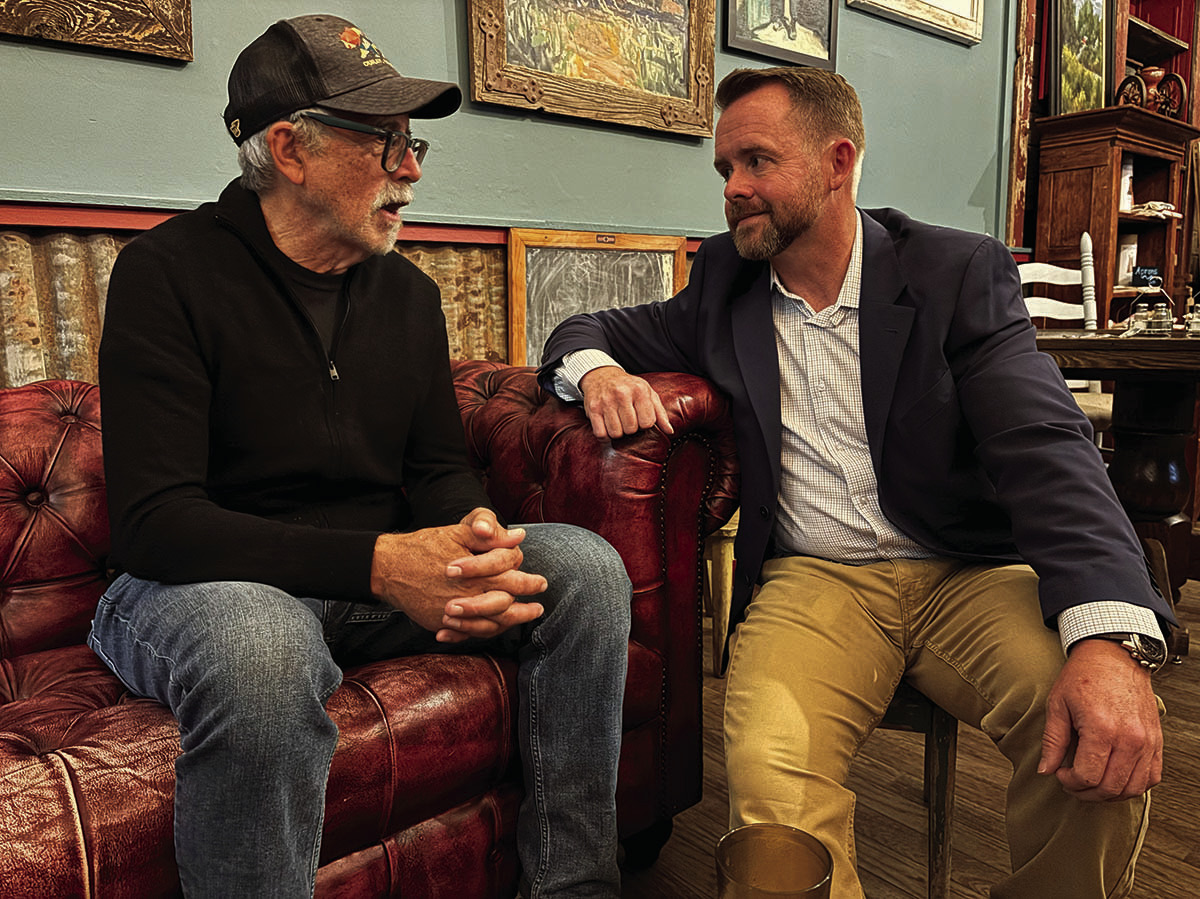
Ouray resident Bruce Ward, left, visits with Interim Police Chief Daric Harvey during a meet-and-greet event at Cassidy’s Cafe & Antiques last week. Dozens of people turned out to visit with Harvey and offer their feedback on his job performance and what they prioritize in the police chief’s job. City Administrator Michelle Metteer said the event is an important part of the process of hiring a permanent police chief. Photo by Mike Wiggins | Ouray County Plaindealer
Harvey said he has been through several background checks and rigorous vetting processes in his 30-year law enforcement career. As part of his 2020 appointment to the Colorado State Parole Board by Gov. Jared Polis, he had to be confirmed by the state Senate. He said the background check Cañon City conducted before hiring him as a police chief in 2017 wasn’t as extensive as the one sought by Metteer.
Harvey said he believes the purpose of a more extensive background check is to unearth details that would disqualify him from the job. He said the initial background check conducted when he was a finalist for the city administrator job in the fall of 2024 didn’t find anything like that.
“So if a background has already been done and those disqualifications weren’t found, what’s the purpose of doing the second (background check)? What’s the purpose of going deeper? What’s the purpose of taking it to the level that every place I have ever lived has to be reported? That’s ridiculous,” he said.
Metteer said the background check is rooted in Rule 29 in the POST manual, which says each agency hiring a police officer should conduct a comprehensive background investigation, which “may” include:
- Criminal record check
- Employment history check
- Driving record check
- Polygraph
- Citizenship or legal residency verification
- Personal history statements
- Neighborhood checks
- Relatives and personal references checks
- Credit records check
- Any other investigative measures the agency finds appropriate
Metteer, who said she planned to have the Durango Police Department carry out the background check, said she verified with POST officials she was following the proper procedures.
She said a POST representative verified it would be considered best practice to follow Rule 29 “in totality.”
“And I thought, great, I’m doing my due diligence in hiring a chief of police,” she said.
Harvey said he reviewed the background check application materials last week and was concerned that Metteer wanted dates of birth and other personal information for his family, including his parents, his ex-wife, his fiancé and his two sons, both of whom he said hold “highly sensitive positions” in the military. He was also surprised by some of the information sought, including all of his bank accounts, every place he’s lived and every driver’s license he’s held since he was 16.
“I mean, it seems a little unreasonable to me, especially for a guy who’s been in law enforcement for 30 years,” he said.
While it is common for agencies to conduct background checks for driving records, criminal records, credit records and personal references, Metteer’s requirement for Harvey to provide his relatives’ personal information went too far, he said.
“And so I just said, ‘Look, I’m willing to meet you halfway. I’m willing to do some stuff, but you know, you’ve got to work with me, too.’”
He said Metteer wasn’t willing to do that.
Asked by the Plaindealer if she would be open to forgoing some elements of the background check, such as seeking information about Harvey’s relatives, Metteer said, “Knowing this is the commitment of the process, I think it’s a very slippery slope when you start considering which parts of a background check to conduct or not conduct.”
Harvey said he was also concerned about what would be done with the information and who would have access to it. He wasn’t satisfied by the answer he said he received from Metteer.
“So if you have this detailed level of information, how do I know where this is going to live? And her response was, it’ll live wherever the city attorney tells me to have it live,” he said.
“That was kind of an additional piece of this, too. That detailed level of critical, sensitive and confidential information, it really sat wrong with me. The purpose here is, is this going to be secure? Who is going to have access to it? How do we make sure that this information to this level of detail isn’t given out?”
Harvey, who served on the POST board when he was the police chief in Cañon City, said the extensive background check is the latest example of what feels to him like Metteer placing obstacles in front of him rather than creating a pathway toward hiring him for the permanent job.
“I’ve been on a job interview for nine months. Have I been perfect? No. Are there things that I could have done better? Absolutely. I’m human,” Harvey said. “But (a background investigation) is to help get to know a person you don’t know, so you make a good hiring risk, and that’s the part that just doesn’t sit with me. It’s like, you already have that. I’ve been here nine months. Why do you need more? I know what the rule says.”
“The only logical conclusion at this point was she was trying to find a way to say no versus a path to say yes, because she had a path to say yes. A very simple and easy one.”
Harvey met with Metteer on Tuesday and said she told him she would not consider hiring him for the permanent job and would instead look for a new police chief because he wasn’t willing to agree to the type of background check she sought. He said he asked if she wanted him to create a transition plan outlining current projects and investigations, noting he had identified a suspect for a break-in at a Ouray home last weekend.
He said Metteer instead suggested he take off the last two weeks of the year, making this week his last week on the job.
Pending approval of the city council, which doesn’t meet again until Jan. 5, Metteer said she intends to conduct a search for another police chief. The city announced in a press release Wednesday night it would work with the Ouray County Sheriffs Office to maintain services and said Ouray Police Sgt. Matt Troxell would “assume leadership reponsibilities of the department.”
Harvey said the fact that the city is again back to square one in its search for a police chief could make it difficult to attract qualified candidates.
“It’s going to be a significant hiccup, if not much worse,” he said.
“The other piece about this is, Ouray’s going to start getting a reputation, because I’m not a Jeff Wood, right?” he said, referring to the previous chief who was fired in the aftermath of a sex assault investigation involving his home. “I’m not a guy that comes in that’s got this checkered past or even had issues before.”
Harvey said he appreciates the support he has received from community members and the relationships he has built, in a place he intended to serve for a long time.
“You know, I bought a house here, and part of it was because of the people that are in this community,” he said. “I’m really grateful for the opportunity to serve as the Ouray police chief.”