



Dodging prairie dog holes, Dana Ivers walked through her roughly 170-acre property on the southern side of Ridgway, admiring the sound and clear color of snowmelt rushing through ditches and into her irrigation pond.
“That’s a good-looking group,” she said, marveling at a bunch of deer along the way.
She sat down at a picnic bench, where the streaming water drowned out the noise of a neighboring property owner clearing and manicuring trees.
Below the irrigation pond, sheepdogs worked a large flock that rippled across the hayfields framed by a postcard shot of the Cimarron Ridge.
Donning a well-loved cowgirl hat with worn feathers, she turned to point out the perfect place for a house, beneath a pine tree on a slope on the west edge of the property. Deer and other wildlife travel through there, so she shrugged off the temptation to build a home in that spot. The animals already had a home there.
Adding irrigation ditches, a donut-shaped pond with an island, some young trees and the picnic bench is all Ivers has done to change the property since she purchased it three years ago.
And now that she has secured a conservation easement with the Colorado West Land Trust, shielding the property from future development, that’s pretty much all that will change.
“It’s a feral piece of property,” Ivers said, smiling about the land she’d wanted to buy and preserve for years.
Ivers owns multiple properties in the area and lives on a parcel she owns up the road. Residents of the Solar Ranch subdivision, which backs up to the new conservation easement, have told her about wildlife they observe on the land and thank her for preserving their views. But she didn’t do it for those human neighbors. She did it for the native ones: deer, hawks, bears, mountain lions. “I have people all the time thanking me, and I’m going, ‘Look, I didn’t do it for you. I’m sorry. I did it for the animals,’” Ivers said.
“I just am thankful these guys have somewhere to come, you know, so they have their view.”
Ridgway resident Dana Ivers walks on her property with her dogs Star and Nico on Monday. The road she’s walking on leads down to the acreage she has preserved and protected from future development, by finalizing a conservation easement with the Colorado West Land Trust. Ivers, a self-described misanthrope, was inspired to preserve the open space for wildlife habitat and continued agricultural use. It remains privately owned but will not be developed. Erin McIntyre | Ouray County Plaindealer
Falling for nature
Ivers isn’t sure just why she loves animals so much. She was 8 when she rode a horse for the first time at a guest ranch in Wyoming. “Nature just got me,” she said.
After that trip, she spent much of her life chasing horses, animals and the outdoors altogether.
Ivers, who grew up in California and Texas, lived in Durango for 40 years and in Telluride for about a decade before moving to Ridgway.
She considers herself a hybrid redneck, connected to the area’s ranching and conservation cultures.
In the early 2000s she began purchasing tracts of undeveloped property in the region, initially for her horses. She soon started conserving land for other animals, creating her first 9-acre conservation easement for a critical wildlife migration corridor in Ridgway in 2001. She became involved in local conservation efforts, including helping preserve the prairie dog population on Telluride’s valley floor and joining Ridgway’s Sustainability Advisory Board.
For a decade, she owned Cow Creek Outfitters, where she rode horses and guided hunters in the Cimarron State Wildlife Area.
From the picnic bench on her property, Ivers looked out at the ridgeline of the Cimarrons, which she calls a second home.
She recalled the time she was cross-country skiing in those mountains, when a mountain lion charged her after stalking her as prey, though it let her go.
“I was gonna get it in the eyeballs (with my ski poles), if I had to,” she said. “I don’t know what made it turn.”
Whether it was luck or timing, Ivers said it felt as if the wild animal had passed its energy to her.
She described the importance of protecting mountain lions’ habitat and that of other animals.
“(Animals) have every right to be here. They’ve been here longer than we have,” Ivers said, shaking her head.
Luck and timing came together to allow Ivers to create her new conservation easement, where mountain lions roam.
Ivers had her eye on the property since she bought her first tract of land in Ridgway around 25 years ago, wanting to preserve the land as a wildlife habitat and prevent development sprawl.
The Colorado West Land Trust, residents of the Solar Ranch subdivision and the town of Ridgway also had their eye on the property for similar reasons.
Ivers was involved in the land trust’s talks about purchasing the property a decade ago, but it was listed for a price neither she nor the nonprofit could afford.
At the time, Ivers had already placed her first 18-acre property in Ridgway and another 18-acre property in conservation easements, preventing a 90-home subdivision and keeping the land available for wildlife habitat.
Three years ago, the owner of the 170-acre property Ivers desired had begun installing survey stakes, mapping out five 35-acre parcels to be sold for development.
It happened that right around that time, a building Ivers owned and had listed for years on Main Street in Telluride finally sold, granting Ivers the money she needed to buy the property.
“I don’t believe in God, but something, the goddess of nature was kicking me in the right direction, whatever it is, whoever it is,” she said.
She put all the money toward purchasing and protecting the land to create one large nearly 200-acre conservation easement, combined with her other two existing easements.
“Had it not sold, we would have been sitting in a subdivision. And nobody wanted that,” Ivers said.
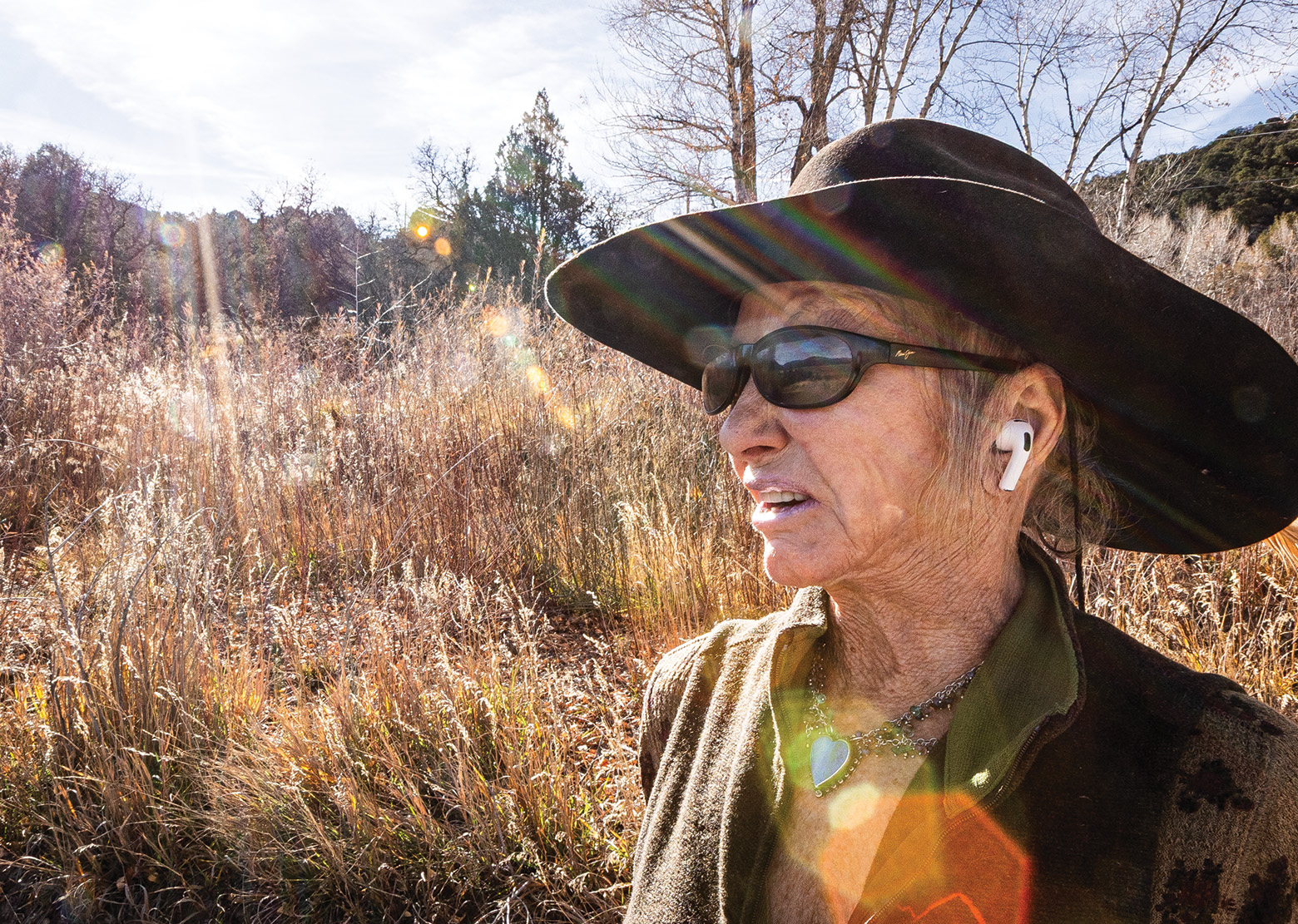
Ridgway resident Dana Ivers looks out at the 170 acres she has preserved with a conservation easement through the Colorado West Land Trust. She decided to call it Pioneers Preserve, in honor of her family’s historic roots in the state. Erin McIntyre | Ouray County Plaindealer
‘A win-win’
By placing her property in a conservation easement, Ivers still owns the property but receives tax credits for giving up development rights on the land.
She’s able to continue its agricultural uses and make small changes, like planting trees, but nothing that would greatly disrupt the landscape. Anyone who owns the land in the future would be subject to those same rules.
It took about three years to secure the easement after purchasing the property. She decided to name it Pioneers Preserve in honor of her family, which has a history in Colorado dating back to the 1860s.
Nick Jacobson, conservation specialist with the Colorado West Land Trust, called Ivers an early pioneer of conservation easements herself, referring to her earlier decisions to protect land from development in 2001 and 2009.
Since Colorado expanded its budget for conservation easement tax credits in 2024, there’s been an increase in residents pursuing easements, resulting in delays getting property appraisals because of a limited number of appraisers in the state. More conservation easements also means Ivers won’t start receiving her tax credits until 2028. But all things considered, Ivers thinks that’s a good problem to have.
According to the land trust, Ivers’ easement is part of 7,800 acres of conserved land within a 10-mile radius.
Jacobson said there’s around 12,000 acres of land conserved under easements within Ouray County.
Still, Ivers thinks more can be done. She believes other locals with land and money misunderstand how conservation easements work and how financially fruitful they can be.
“Honestly, it’s such a win-win. I mean, you can look at your property and you’ve got money,” Ivers said.
Conservation easements can be more flexible than some might think, allowing property owners to develop within building envelopes or continue certain commercial or recreational activities, as long as they are included in the easement terms.
Ivers hopes her action will encourage others to do the same and slow the area’s development, and in doing so, protect wildlife habitat.
“I like open space. I don’t like people. I’m sorry, I wasn’t kidding when I said humans are a pestilence, we are,” Ivers said.
“But anyway, at least (the easement) happened, and I’m thrilled to death.”
Lia Salvatierra is a journalist with Report for America, a service program that helps boost underserved areas with more reporting resources. To help the Plaindealer continue to provide this kind of reporting, you can make a tax-deductible donation to support her work here.