



At daybreak, Dustin Mullins saw the wisp of smoke rising to the east. He was getting ready to hunt with some others that morning at his ranch and saw the beginnings of the fire, near Courthouse Mountain.
At first he wondered if it was on his own property. But it was in another drainage, roughly a mile away from the edge of his ranch.
It was the start of the Cow Creek Fire, which burned 859 acres last October and cost $2.2 million to fight. It was unusual to have a fire start so late in the fall, long after fire season typically peaks in western Colorado.
“It got big fast,” Mullins said. “It was scary how dry it was.”
Though this fire wasn’t on his land this time, Mullins knows the ongoing drought means he’ll likely contend with fires at some point on his ranch. This year has brought hazy conditions, smoke and a reminder from the largest fire in Colorado’s history – the Pine Gulch Fire in Mesa County – that fire is a frequent visitor to the West.
That’s one of the reasons Mullins is partnering with federal agencies to participate in a fire mitigation project on part of his property as well as public lands, with one of the goals being to harden his property against fire and make it more defensible when it sparks.
The Baldy Mountain Landscape Resiliency and Habitat Improvement Project is proposed for roughly 2,000 acres of U.S. Forest Service lands, 870 acres of Bureau of Land Management property and 1,428 acres of the Mullins Ranch. The goal is to reduce fuels, increase habitat and forage for wildlife including bighorn sheep, elk and mule deer and to improve rangeland conditions. Prescribed fire is recommended for up to 3,000 acres of the area, and the project also includes mechanical treatments to remove vegetation.
“We’ve really seen a lack of fire on that landscape and it’s really caused a buildup of vegetation,” said Dana Gardunio, U.S. Forest Service Ouray district ranger. “You can see some beetle kill, a lot of dead, standing timber. Bringing that fire back to the landscape will help reduce some of the fuel loading there. And that’s really for preventing the spread of future wildfire.”
Mullins’ property is on the north end of the project, which would stretch all the way down to BLM and Forest Service land near Portland. The partnership allows the fire managers to treat the entire landscape – as fire doesn’t respect property boundaries.
“We can really treat that area as a whole landscape and not look at the boundaries of whose land is whose,” Gardunio said.
It’s not the first time the Mullins property has undergone fire mitigation work – it’s something Dustin’s family has undertaken with other partners over the past few decades, including the Natural Resources Conservation Service and the Colorado State Forest Service. But this is the first project of this scale, involving prescribed fire between private and federal lands, in which the Mullins have been involved.
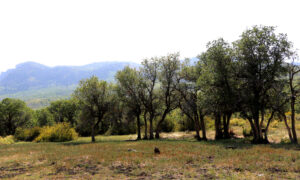
In 2017, the ranch received help with building a fire line and mechanical treatments to thin fuels in mostly pinon-juniper woodland. Another project in 2012 involved treating large tracts of oakbrush, which had become so crowded and dense that animals couldn’t move through it, the shrubbery crowded out good forage for animals and livestock and it didn’t provide much defense against fires.
Now, some of that oakbrush is up to six-foot-tall Mullins’ waist, and even his shoulder in some spots. It bounced back even stronger than before in some spots.
Ranch owner Dustin Mullins surveys the landscape during the Baldy Mountain project tour’s first stop on June 22. Mullins first began working with the U.S. Forest Service in 2015 to reduce fire risk and improve elk and mule deer habitat on his property. Daniel Schmidt — Ouray County Plaindealer
“We’ve just been able to nibble away at it,” said Steve Woodis, a wildlife biologist who retired from the NRCS in 2018 but has continued to work with the landowners on projects. “We prepared as much that we can physically do on the ranch independent of the Forest Service and the BLM.”
Mullins, 36, said he’s grateful for the opportunity. For him, the priority of increasing the habitat and forage for wildlife and his livestock is about equal to the benefits of fire mitigation and making his property more defensible against massive wildfires in the future.
Though last year started as a top-five record water year in the area, with ample snowpack and runoff, it ended incredibly dry and the southwestern part of Colorado dipped back into a drought. This year, the ranch received scarce moisture in April and May, leading to tinder-dry conditions and poor forage for Mullins’ livestock and wild animals. Some of the springs on the property have dried up, making it difficult to move cattle around just from the simple fact they can’t graze miles away from a water source.
“The grass might be better up higher, but it’s a two-mile walk to water,” he said. “It’s been rough.”
This year has been, in some ways, just as bad as 2018. Ranchers like Mullins negotiate the ups and downs of what Mother Nature gives them – and lately they’ve been dealt extremes.
He’s noticed changes to the landscape, as a result of cllimate change, and has decided to take an active role in managing the landscape to hedge against more extreme temperatures and future drought years bringing more fire danger.
Mullins moved here permanently in 2014 from Virginia, to the ranch his grandfather originally purchased in 1977 and pieced together from more than a dozen different parcels. He started coming here himself to hunt when he was as young as 12, flying out for just a few days ata time.
Now, he and his wife Cristina are raising their children and running a cow-calf operation of mostly Simmental-Angus crosses. They’re generally pretty private folks who don’t want attention. But Mullins said he knows he will get some interest when the time is right for the prescribed burns, and wants people to know why he agreed to be a partner in the project.
The last time they built a fire line, rumors sprouted in town. Some speculated there was a new ski resort starting up, others wondered if a pipeline was going in or new utilities were being constructed. And that project didn’t even involve smoke.
Federal officials are anticipating some concern about burning, given the visibility of the project from Ridgway. But they want people to know fire is a useful tool for maintaining forest health, and that the payoff for a controlled burn done correctly is worth the small inconvenience of a little smoke.
“The impacts are that we will have some smoke in the air temporarily and that definitely gets people a little curious and maybe a little nervous about what’s going on,” said Gardunio. “It’s sort of one of those short-term impacts for long-term benefit overall.”
Mechanical treatments are a good tool for areas where fire managers want to be more selective about vegetation, and also when fire conditions aren’t optimal for a controlled burn. Another factor managers have to weigh is whether the resources to set, manage and potentially contain a prescribed burn is available and in that case, those who are out fighting fires already might be maxed out and unavailable for the project.
Having the available resources to contain the fire after it is ignited is vital, as a prescribed burn isn’t without risk. A prescribed burn last October, managed by the Nature Conservancy near Red Feather Lakes, spread quickly during dry conditions and led to the Elk Fire.
One of the mechanical treatments involves a Hydro Ax machine, resembling a front-end loader, with a grinder instead of a bucket. The operator can target specific trees for removal. “It’s very surgical,” said Woodis.
But fire is recommended for certain areas, because machines can’t quite reach some places or areas with steep slopes, and also fire can be much more cost-effective and regenerative if used correctly and managed closely.
“We’re talking low, creeping fire through the understory,” said Gardunio. “We’re not talking about sending fire into the canopy and torching across.”
The proposed treatments will likely be spread out over several years, and it’s difficult to know exactly when prescribed burns would happen. If the project receives final approval in 2021, the soonest Gardunio anticipates prescribed burns happening is roughly a year from now. Several factors come into play – including fuel conditions, weather and climate forecasts, and the availability of resources aligning to provide an optimal “burn window,” which typically arises in the spring or fall.
For those who haven’t seen a prescribed burn before, they might picture a blackened hillside, with every bit of vegetation torched to ash. But that’s not what happens, said Mullins.
“It kinda makes its own little mosaic,” he said, leaving patches of burned areas and other areas untouched.
One of his biggest concerns about doing any sort of prescribed burns without help from federal agencies is liability. He doesn’t have the resources to defend against an out-of-control fire, and doesn’t want to take on the responsibility of what might happen if it became unwieldy. His 4,700-acre ranch is much larger than some other agricultural operations where farmers burn ditches in the springtime.
“They understand fire behavior,” he said. “If you’re going to set a fire, you’ve really got to do your homework.”
For the Baldy Mountain project, that means having clear parameters, making sure the conditions are just right for the treatments and not taking chances if they aren’t optimal.
“The whole team involved feels very comfortable before we light that match and it hits the ground,” Gardunio said. It feels good to have that team and the agencies involved in the project, Mullins said.
“There’s way too much liability on a private landowner to go and do a prescribed burn,” Mullins said. He’s counting on the expertise of everyone and their knowledge of fire science, and the relationship he’s built with experts like Woodis over the years to guide the project. He hopes this project bringing together federal, state and local partners will show other private landowners how they can do similar projects in the future.
“We sorta figure it’s a once in a lifetime opportunity,” he said. “We don’t want to look a gift horse in the mouth.”