



Residents forced to flee the Gold Mountain Fire north of Ouray nearly two weeks ago returned to charred landscapes but fully intact homes Wednesday, an indication that authorities believe the threat has subsided in the areas closest to where the fire ignited.
Ouray County Sheriff Justin Perry lifted the mandatory evacuation order for more than 130 homes in two evacuation zones along the U.S. Highway 550 corridor from County Road 14 north to Cedar Hill Cemetery. Homeowners who obtained credentials were escorted into the zones by sheriff’s deputies. It’s unclear how many people were evacuated, since some of the homes were unoccupied. The re-entry areas were expected to remain closed to the public for at least 72 hours.
Panoramic Heights resident Will Geyer waits for Ouray County Sheriff’s Sgt. Derrick Linnell to check his pass to re-enter the mandatory evacuation zone just after it reopened to residents on Wednesday morning. Sheriff Justin Perry ordered the area to reopen to credentialed residents, and said the closure to the general public was expected to last 72 hours. It’s unclear how many residents had to evacuate, as some homes are occupied seasonally, but 139 homes are located in the zones that were evacuated on June 27 when the fire started and reopened on Wednesday, according to Ouray County Assessor Susie Mayfield.
Erin McIntyre – Ouray County Plaindealer
“When we have days like today, when we get a few wins, that means a lot to me,” Perry said late Tuesday night, nearly two hours after sheriff’s officials announced they would allow some residents to return home.
A voluntary evacuation order is now in effect for those two zones, 12 and 13, which include Panoramic Heights, Lake Lenore, Ponderosa Village, Peck’s Trailer Park and other homes east of the highway.
Mandatory evacuation orders remain in place for areas east and north of Ridgway, including properties along county roads 8, 10 and 12, north of Baldy Mountain.
Firefighters gained a small but critical foothold on the fire this week as it pushed northeast away from the most heavily populated areas of Ouray County and triggered voluntary and mandatory evacuations in remote southern corners of Montrose and Gunnison counties.
Fire activity quieted Tuesday, aided by light showers, cloud cover and higher humidity. But chances for wetting rains remain low, according to the National Weather Service, while critical fire weather conditions were expected to re-emerge today (Thursday). Forecasters called for high temperatures in Ouray County to climb into the mid-80s and low 90s through early next week.
Faced with windy, tinder-dry conditions, warm temperatures and steep terrain days earlier, firefighters counterpunched on Monday by using drones, helicopters and hand crews to ignite fires to help control the main fire and connect firelines to create containment.
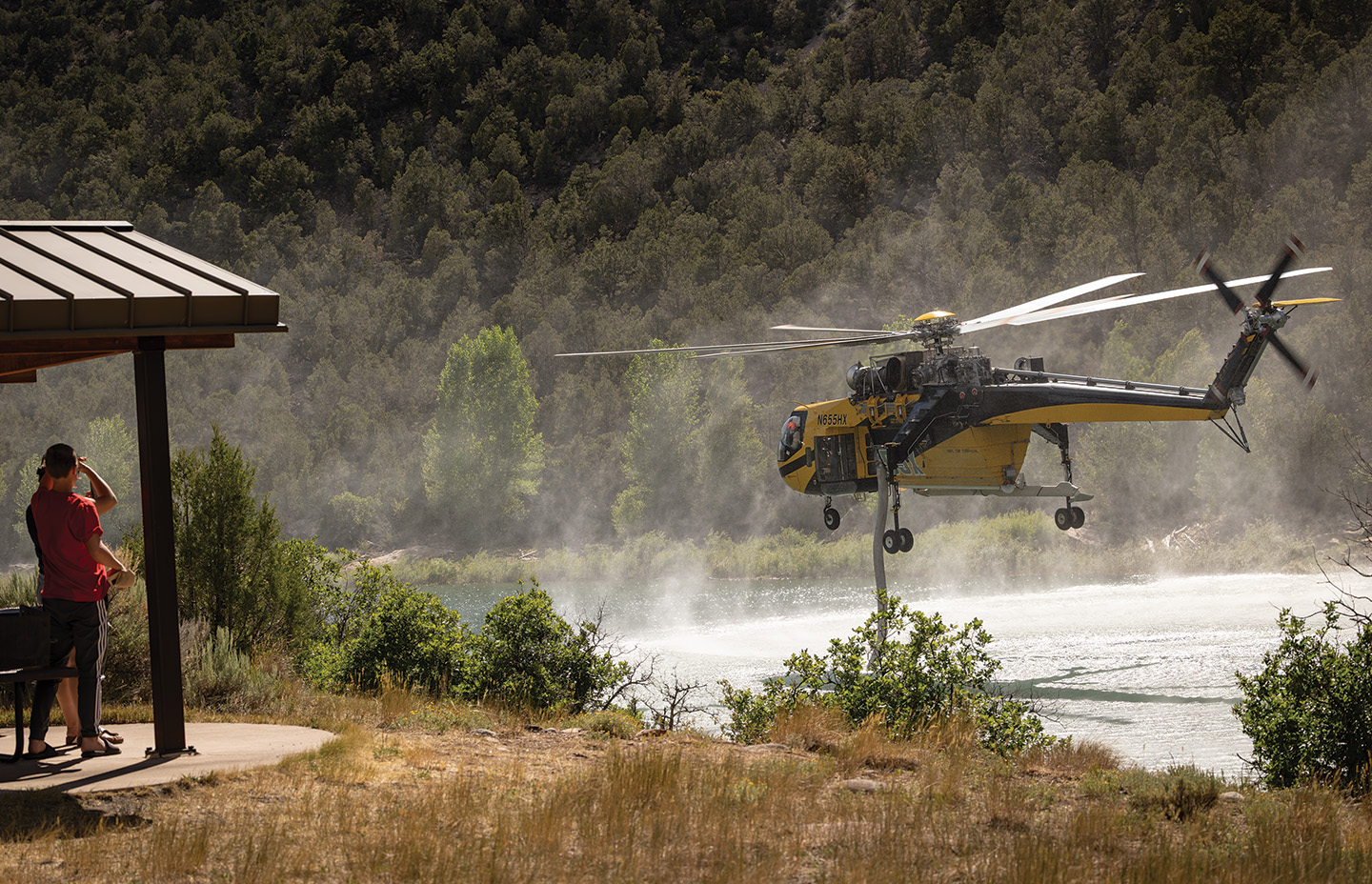
Fixed-wing airplanes and helicopters repeatedly dropped slurry and water in the Cutler Creek drainage and along the cliffs on the western edge of the fire to keep it from spreading toward U.S. 550. Officials said Wednesday infrared mapping indicates very little heat remains along the highway corridor, and that they expect little fire growth there.
Those combined efforts allowed firefighters to gain containment on the fire for the first time since it ignited June 27 two miles north of Ouray. As of Wednesday morning, the fire had scorched 31,420 acres and was estimated to be 8% contained. It’s currently the third-largest fire burning in Colorado, with 976 personnel assigned to it.
The fire has destroyed at least one cabin and historic mining structures but has not claimed any homes.
House saved, beloved cat lost
John Summers had just sat down to eat dinner the night the fire started when he saw a wisp of smoke rising from an area the locals call Jackass Flats, just to the south of his house on Lake Lenore.
“I saw a little bit of orange flames, and I’m starting to eat my dinner and this guy rolls up here and said, ‘You have to evacuate.'” “I thought, ‘Well, I’ll finish my dinner,’ but then the power went off,” he said.
Summers, a retired pilot who used to keep a helicopter at his home above Ouray, was wishing he had one then to somehow help douse the small fire.
He realized without electricity, his water pump wouldn’t work, and he’d better leave. He grabbed his cat, Scooter, some important papers, some money and clothes and essentials, and left.
He spent part of the night watching the fire down below, near the bridge to Whispering Pines, and he fell asleep in his car, by the river. That was the last time he saw his cat.
“When I woke up, I noticed the car was real quiet, and I thought she was hiding under the seats … but I dug all around my car and she was gone.”
He’s still hopeful Scooter might turn up, and after being gone from home for 11 days he feels pretty safe back at his place on the lake.
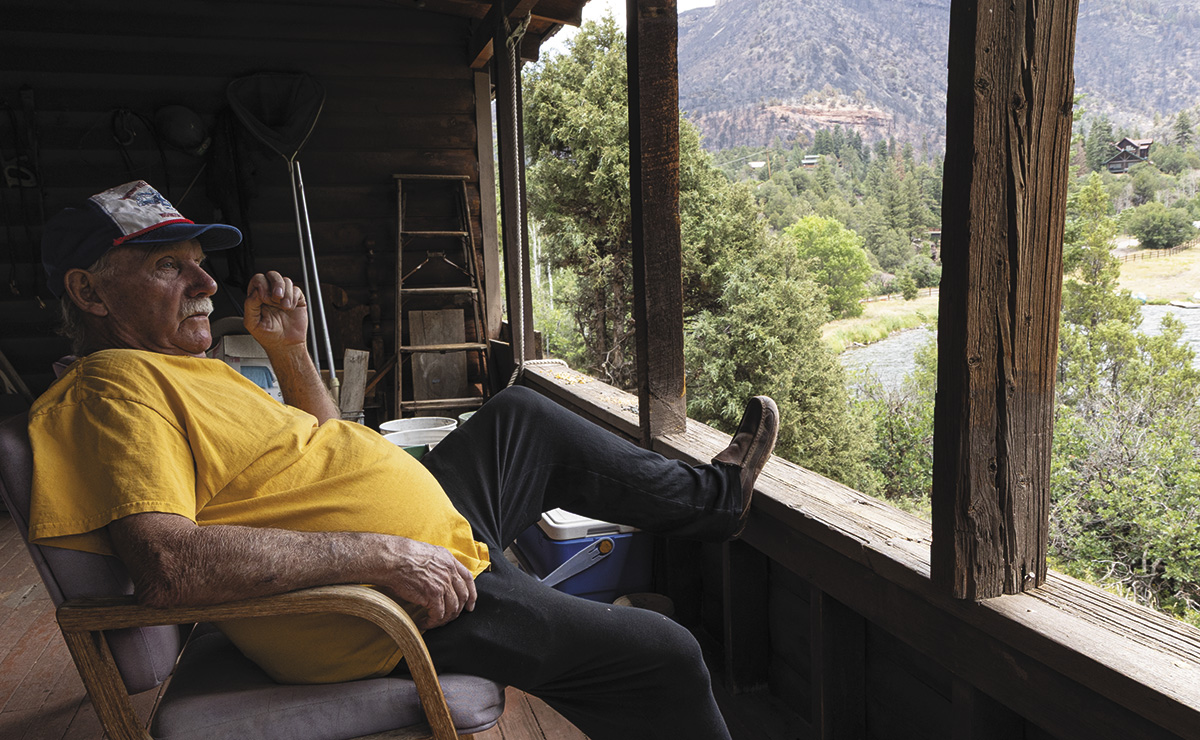
Lake Lenore resident John Summers surveys the damage on the hills above his neighbors’ homes on the lake on Wednesday morning, after he was allowed to re-enter the evacuation zone. Summers is still looking for his cat, Scooter, who ran away after they evacuated on June 27. He believes the cat escaped his vehicle near the bridge to Whispering Pines that night. Erin McIntyre – Ouray County Plaindealer
“I think the fire danger is about normal,” he said. “If you live in a place like this, in the woods, there’s always some of that danger around.”
The 80-year-old Summers, who has lived here since 1982, called evacuating an “interesting adventure” and said he’s grateful his house still stands, but he’s worried about his cat and fears she’s gone.
“It will take me a while to put myself together,” he said.
Evacuees thankful for firefighters, gain wisdom
Before the sheriff’s office announced Tuesday night they would lift the mandatory evacuation order for some areas, evacuees expressed gratitude for the firefighters working tirelessly to quell the flames and said they’re a bit wiser about what they will take if such an event happens again.
Panoramic Heights residents were taking their circumstances in stride and finding silver linings despite everything they have gone through.
Jill Mort is glad Walden the Wonder Cat, as she calls him, is in his happy place staying in the family’s 1986 Dolphin RV, which they call “The Whale.”
Patty Blackford is happy she and her husband, Rick, were able to put out buckets of water for wildlife and seed for birds when they were allowed to visit their home for a few minutes last week.
“We’re doing fine, thanks to the kindness and generosity of our friends,” Mort said.
She and her husband already had tubs filled with keepsakes and valuables long before the fire, so all they needed to grab were clothes and medication.
She wishes she could have brought a few five-gallon kegs of her home brew with her.
“Now I have to buy beer,” she quipped. While the Morts stayed with friends, they parked their 40-year-old RV, and 14-year-old Walden stayed there. Typically, when the Morts are in their house, Walden likes sleeping in the RV, so he’s oblivious to the current chaos around him.
Mort anticipates emptying the refrigerator of rotten food and massive cleaning to get rid of the smoky smell, but said it’s worth it to be safe.
“We are doing what we’re told and thankful to the firefighters for doing their jobs and keeping us safe,” she said.
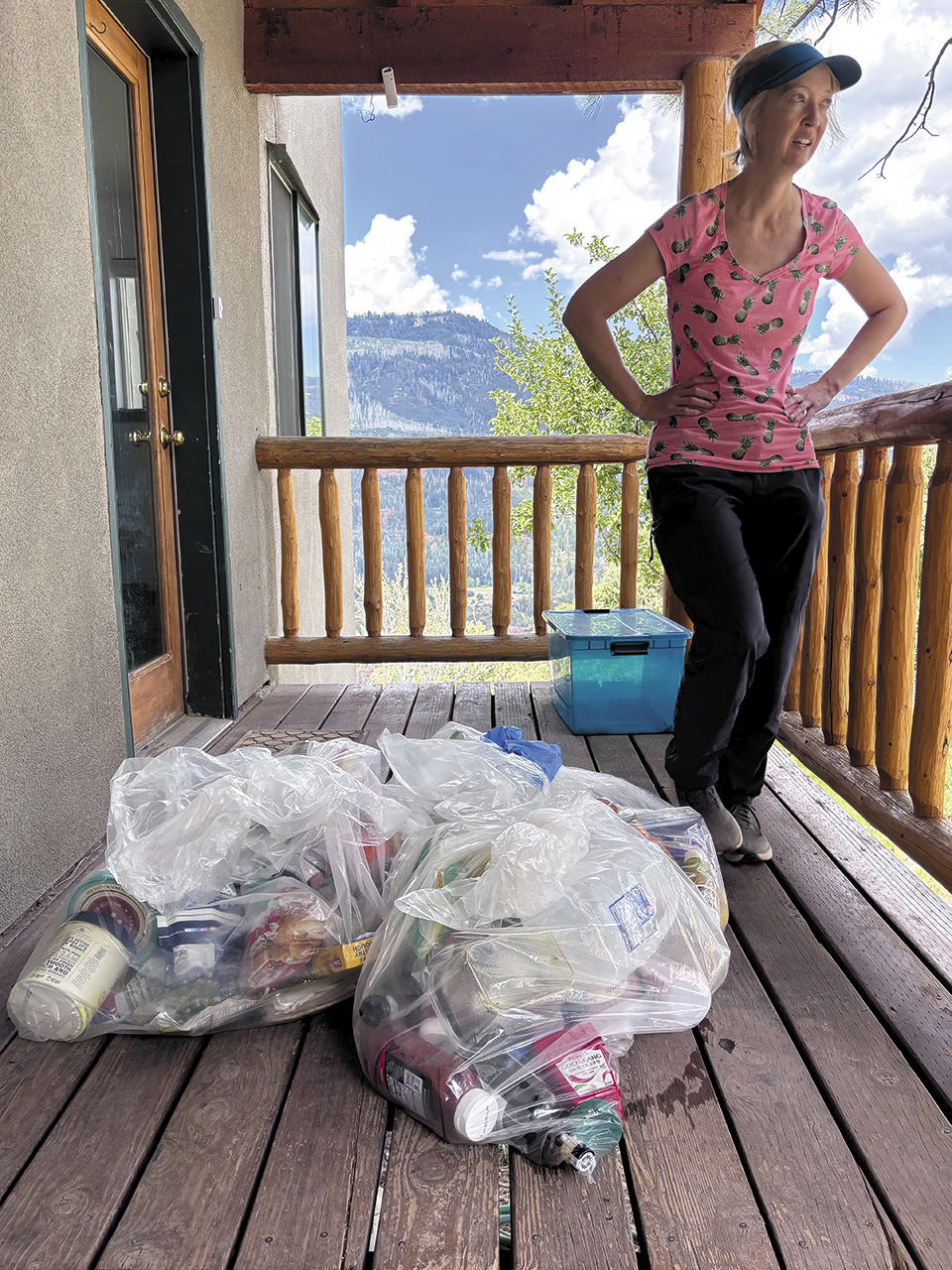
Rachel Nichols assesses some of the burn damage on the hill behind her home of County Road 14A as she takes a short break from collecting rotten food from her kitchen. The power was off at the homes in the mandatory evacuation area for days, so evacuees who returned home face cleaning out the spoiled contents of their refrigerators and freezers. Black Hills Energy workers were going door to door when evacuees returned, to restore natural gas service, and power had been restored. Erin McIntyre – Ouray County Plaindealer
Keeping a watchful eye from home
Christine Witherspoon has a baseball cap that says, “Professional Cat Herder.” She put that vocation to the test after seeing flames from her home in Peck’s Trailer Park the day the fire broke out.
She took her eight cats to be sheltered from the fire at Ridgway Animal Hospital. She brought the last two home last week.
“We saw the fire right above our home,” she said. “You could see it coming. It’s been very stressful.”
She and her husband Ed decided not to evacuate from their home of 46 years. Instead, for several nights, they took turns staying up all night to make sure they were ready to leave if necessary. They turned off their propane tank and sprayed water around the house.
Witherspoon said their three daughters were supportive and encouraging during the ordeal. Their daughter in Montrose took keepsakes and important papers to her home.
“You could spend eternity trying to decide what to keep,” she said. “The main thing is I got my kitties out, and that was a relief.”
Witherspoon said she’s known for years that a wildfire was imminent.
“I told my husband years ago I hope there’s not a match or a cigarette flicked out,” she said. “It just takes one, and it’s all over.”
Lifting the evacuation order
Kristie Thompson, a public information officer for the Rocky Mountain Complex Incident Management Team 3, told the Plaindealer incident management team members have met regularly with and Ouray County Emergency Manager Glenn Boyd since the team assumed management of the fire on June 29 to discuss evacuations. She said the incident management team makes those recommendations, but the final decision rests with the sheriff.
Perry told the Plaindealer he decided to lift the evacuation order in the two zones based on input from the incident management team’s operations chief and incident commander.
“It’s really a recommendation after they have done all their work in securing the safety of the area,” he said.
The pressure he feels to make the final call is “incredibly difficult, incredibly challenging,” Perry said, noting he faces the responsibility of ensuring safety while also considering people’s constitutional and private property rights. Ultimately, though, “it’s time for people to get back into their homes,” he said.
While the majority of residents heeded the evacuation order, some refused to leave. One person in the Dexter Creek area who insisted on staying behind on the first day of the fire reconsidered and left on the second day, Perry said. Three Panoramic Heights residents also remained in their homes. A few in the Red Stone Road area initially left, then returned, only to watch the fire blow up in the Cutler Creek drainage, he said.
Residents seeking to return to their homes were required to provide documentation showing the address of a property in the previously evacuated areas. Authorities then gave them credentials.
Perry said those re-entry credentials were meant to ensure the appropriate people are re-entering those areas and deter any suspicious or nefarious behavior.
“We want to make sure each one of these homes, when they are repopulated, they’re actually repopulated by the homeowners or people who are supposed to be there,” he said. “I would feel horrible if I just opened it up and somebody who didn’t belong in a home went into a home, and then we had a criminal issue to deal with.”
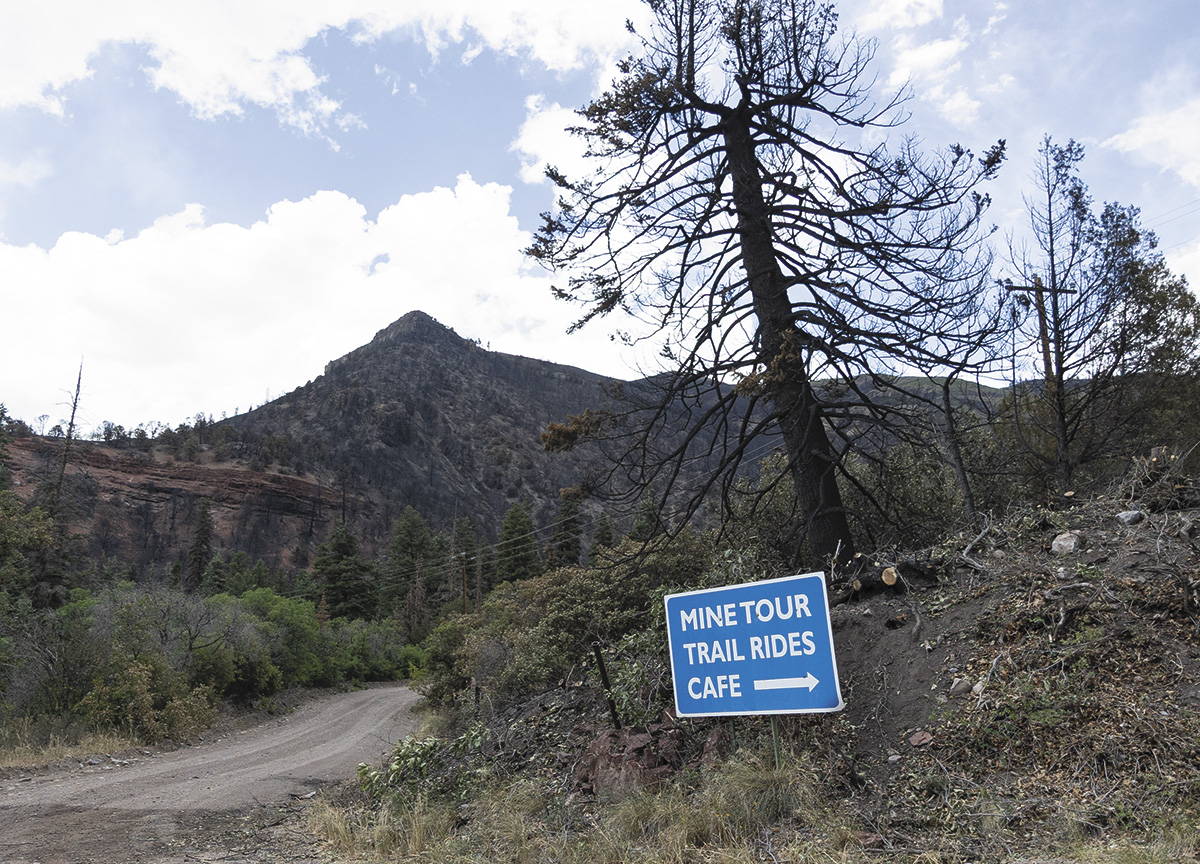
The firefighting crews and aerial operations were able to hold the Gold Mountain Fire above County Road 14 and 14A, where the fire dipped down as far as the turnoff for the Bachelor-Syracuse Mine, at County Road 14C and Gold Mountain Trail. Firefighters were able to preserve all the homes in the area. The fire destroyed historic mine ruins at the Newsboy Mine and a family’s cabin.
Erin McIntyre – Ouray County Plaindealer
Where the fire is headed
The fire has climbed Owl Creek Pass and dropped into the West Fork of the Cimarron Basin, where it’s churning through steep, heavily forested terrain. Crews are working to keep the flames south of Silver Jack Reservoir. A wide swath of the Uncompahgre National Forest remains evacuated and closed.
Fire managers say most of the fire is burning in the Uncompahgre Wilderness, which hasn’t burned in more than 50 years. A combination of heavy, dead timber, dry vegetation, prolonged drought, below-average precipitation and historically low snowpack has created conditions that encourage active fire behavior.